Argenta Silver Corp (AGAG) July 2026 Snapshot: D-Grade Silver Explorer
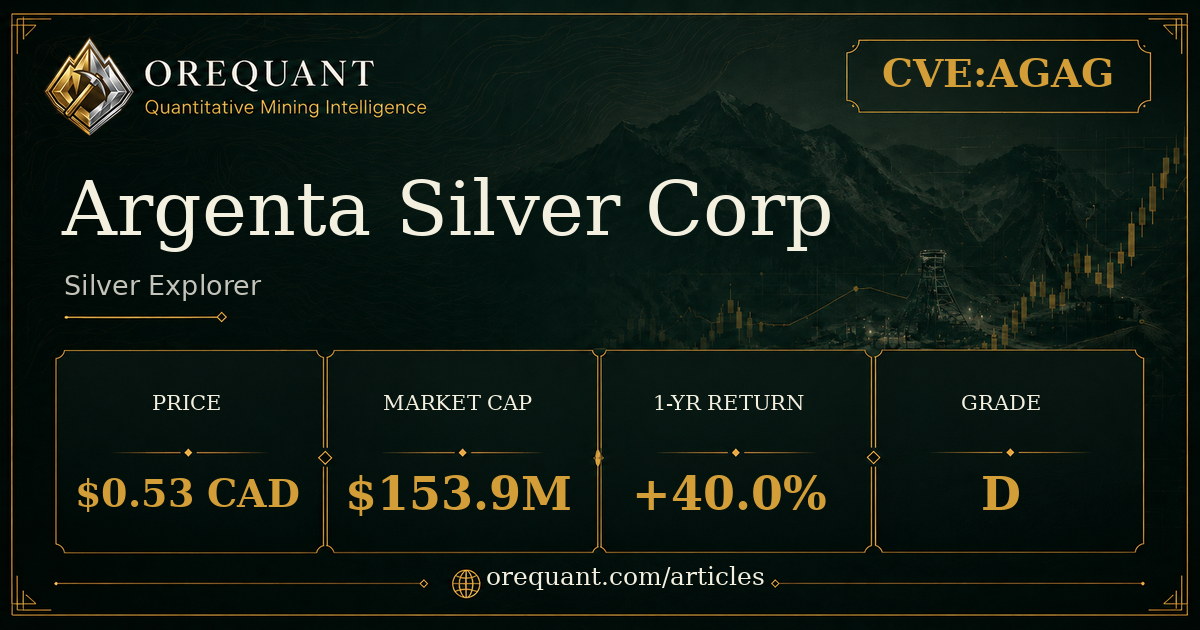
| Share price | $0.53 CAD |
|---|---|
| Market cap | $153.9M |
| 1-year return | +40.0% |
| 1-month return | -15.5% |
| OreQuant quality grade | D |
| Classification | explorer |
See the full signal depth behind this snapshot →
At a Glance
Argenta Silver Corp (CVE:AGAG) trades at C$0.53 per share with a market capitalization of approximately $154 million USD. The company is classified as an explorer — a pre-production entity focused on exploration and resource definition that may require external capital to advance its projects. OreQuant's grading framework assigns AGAG a D-grade, the relative rating band reflecting the lower tier of assessed names in the current public-data scoring set.
Recent price performance presents a split picture. Over the past month, AGAG has declined 15.52%. Over the trailing twelve months, the stock has gained 40.0% — placing the near-term pullback against a broader period of positive price momentum.
Among the five listed peers, all operating in a comparable market-cap range, AGAG's one-year return lags Silver X Mining (CVE:AGX) at 208% and West Point Gold Corp (CVE:WPG) at 186%. Apollo Silver (CVE:APGO) posted a comparable 41% gain. The two B-grade peers — Minaurum Silver (CVE:MGG) at 44% and Sun Silver Ltd (ASX:SS1) at 0% — bracket AGAG's return from above and below.
The B-grade peers, by contrast, delivered the narrowest return spread of the group.
With 290,337,000 shares outstanding, the share count itself situates AGAG within the upper portion of the micro-cap explorer range, where liquidity conditions can amplify both upward and downward price moves relative to institutional-grade issuers.
Ground and Targets
Argenta Silver Corp holds its entire project portfolio in Argentina, operating within a single regulatory and macroeconomic environment. The company's primary commodity is silver, and all five named projects — Azufre, Mani-Copan, El Quevar, Yaxtché, and Andrea — sit within Argentine jurisdiction.
A multi-project land package of this scale is typical for early-stage silver explorers seeking to identify one or more economically viable targets before advancing toward a formal resource estimate. Portfolio breadth spreads geological risk across multiple targets, offering the possibility that a discovery on one property compensates for disappointing results on another. However, the same breadth means exploration capital must be allocated across several fronts simultaneously, which can slow the pace of advancement at any individual property and complicate prioritization decisions as financing constraints tighten.
The five projects span a range of names — Azufre, Mani-Copan, El Quevar, Yaxtché, and Andrea — each representing a discrete land position within Argentina. Operating all five within a single national jurisdiction concentrates both regulatory risk and logistical overhead.
Argentina has historically presented a complex operating environment for mining companies. Currency controls, export duties, and periodic policy shifts have been structural considerations for operators in the country. For a pre-production explorer, these factors bear on permitting timelines, repatriation of future proceeds, and the cost of sustaining in-country field operations. These risks apply across the Argentine junior mining sector, not to AGAG alone. That said, single-jurisdiction concentration means AGAG carries no geographic diversification buffer of the kind available to explorers with assets spread across multiple countries or continents.
With approximately 290 million shares outstanding, the capital structure reflects the equity issuance common to exploration-stage companies.
OreQuant scores every company across 11 signal layers, updated daily. Start Your 7-Day Free Trial to see the full breakdown behind this snapshot.
Capital and Burn Rate
Argenta Silver Corp reported zero revenue on a trailing twelve-month basis through Q1 2026. A nil revenue figure is structurally expected for an explorer: with no producing assets, there is no operating cash flow. Every dollar of field work, permitting, and corporate overhead must be sourced externally — through equity issuance, debt, or both. The absence of revenue also means the company has no internal mechanism to offset losses as exploration activity continues.
At this burn level, the balance sheet requires periodic replenishment from capital markets. The pace and terms of that replenishment directly affect the share count noted above.
Pre-revenue explorers in the silver sector face a structural dependency on investor sentiment toward the underlying metal. When silver prices are strong, financing windows tend to be more accessible and can often be completed with less dilutive terms. When sentiment softens, the same burn rate becomes harder to sustain without significant dilution. The interplay between silver price momentum, share price, and financing cost forms a feedback loop that is particularly pronounced for companies at the explorer stage.
The peer group underscores the financing dynamic.
That compression in market capitalization across the cohort — even as return profiles diverge sharply — reflects how investor capital in the junior silver space tends to rotate among names rather than accumulate uniformly.
Why It Matters
The combination of a single-jurisdiction footprint in Argentina and the trailing net loss cited above creates a specific vulnerability profile. Argentine macro conditions — including currency policy and regulatory shifts — can compress or expand the effective cost of in-country operations without any company-specific trigger. A pre-revenue explorer has limited buffers when jurisdiction and commodity price headwinds converge simultaneously. For AGAG, all five projects face that same jurisdiction risk in parallel, with no geographically distinct asset to provide insulation.
The one-year gain reflects a period of positive price momentum, but the single-month decline signals that this momentum has recently stalled. Among peers, the higher-returning names — Silver X Mining and West Point Gold — carry D-grade ratings as well, indicating that grade alone does not predict return dispersion within this cohort. The B-grade peers delivered more modest returns over the same period, further illustrating that grade and near-term return do not move in lockstep at this end of the market-cap spectrum.
Explorer-stage companies with elevated share counts and ongoing burn rates carry a latent dilution risk that becomes more visible when the share price weakens. That dynamic, when sustained, can weigh on per-share metrics even if the underlying project portfolio remains unchanged.
For a company at this stage — pre-revenue, single-jurisdiction, with a meaningful trailing burn rate — near-term price trajectory remains tightly coupled to silver market sentiment and the company's next financing event. Investors tracking AGAG alongside its silver explorer peers should note that the peer cohort's wide return dispersion is a feature of this market segment, not an anomaly specific to AGAG. AGAG's current positioning reflects a name that warrants close monitoring within the context of the broader Argentine silver exploration landscape.
Sector peer comparison
| Company | Ticker | Market cap | 1-yr return | Grade |
|---|---|---|---|---|
| West Point Gold Corp | WPG | $164.1M | +186.0% | D |
| Apollo Silver | APGO | $164.3M | +41.0% | D |
| Silver X Mining | AGX | $138.8M | +208.0% | D |
| Minaurum Silver | MGG | $173.8M | +44.0% | B |
| Sun Silver Ltd | SS1 | $173.9M | — | B |
Peers ranked by market-cap proximity within the same commodity and producer tier. Market data and quality grades are public; OreQuant's full signal-layer scores are subscriber-only.
Frequently Asked Questions
What is Argenta Silver Corp's company classification?
Argenta Silver Corp is classified as an explorer — a pre-production entity focused on exploration and resource definition that may require external capital to advance its projects.
Where are AGAG's projects located?
All five of AGAG's named projects — Azufre, Mani-Copan, El Quevar, Yaxtché, and Andrea — are located in Argentina.
How has AGAG's share price performed over the past year?
AGAG has gained 40.0% over the trailing twelve months, though it has declined 15.52% over the most recent one-month period.
What is AGAG's revenue on a trailing twelve-month basis?
Argenta Silver Corp reported zero revenue on a trailing twelve-month basis through Q1 2026, consistent with its pre-production explorer status.
How does AGAG's OreQuant grade compare with its peers?
AGAG holds a D-grade. Three of its five listed peers — Silver X Mining, West Point Gold Corp, and Apollo Silver — also carry D-grades. The remaining two peers, Minaurum Silver and Sun Silver Ltd, are rated B-grade.
Risk & Disclosure
Silver mining equities carry substantial risk including commodity-price volatility, operational disruptions, jurisdictional changes, and capital allocation missteps. Senior producers mitigate some risks through diversification and scale, but remain sensitive to metal prices, cost inflation, and geopolitical developments. Junior and exploration-stage companies carry additional risk including total loss of capital. Past performance does not predict future results.
Investors should be prepared for double-digit intraday swings and should conduct independent due diligence, assess risk tolerance, and consult a licensed financial professional before initiating or modifying positions in mining equities.
OreQuant is not a registered investment advisor. This content is for informational and educational purposes only. It is not investment advice. Always conduct your own due diligence and consult a licensed financial professional before making investment decisions. Mining equities — especially juniors — carry substantial risk including total loss of capital.
Subscribers access the full signal depth behind this snapshot — individual scores, insider cluster details, Monte Carlo valuation, and position sizing updated daily. Start Your 7-Day Free Trial.