Aftermath Silver (AAG) July 2026 Snapshot: C-Grade Copper-Gold Explorer
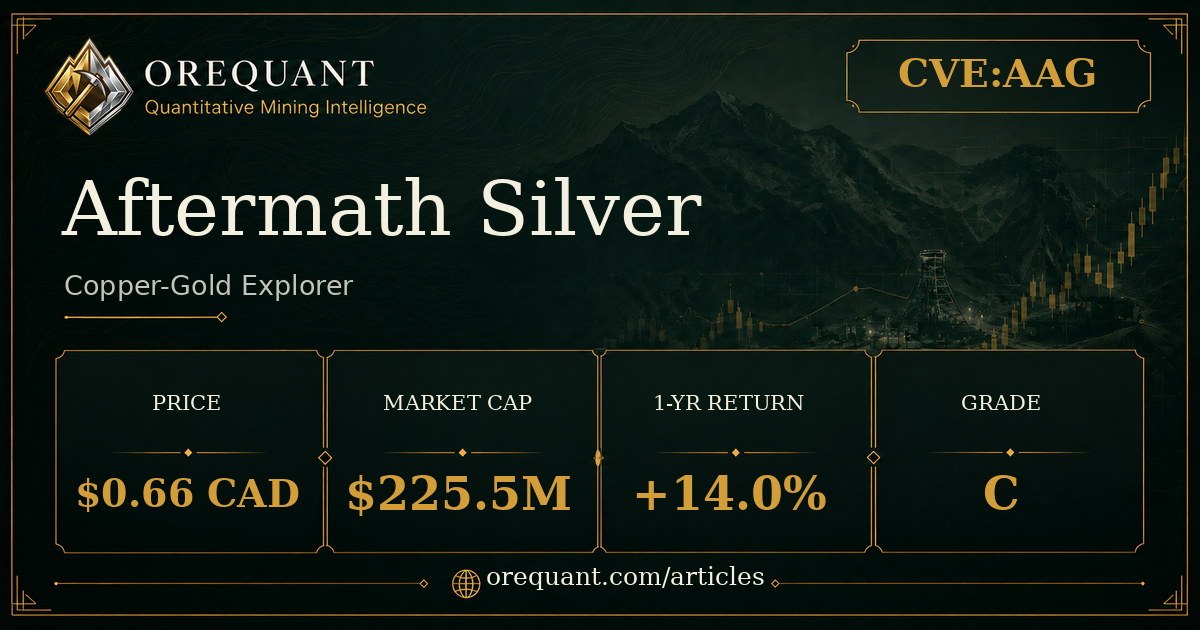
| Share price | $0.66 CAD |
|---|---|
| Market cap | $225.5M |
| 1-year return | +14.0% |
| OreQuant quality grade | C |
| Classification | explorer |
See the full signal depth behind this snapshot →
At a Glance
Aftermath Silver (CVE:AAG) trades at C$0.66 per share with a market capitalization of approximately $225 million USD. The company is classified as a silver explorer — pre-production, zero revenue, and structurally dependent on external capital to advance its project portfolio. The one-year price return stands at 14%, while the one-month change is flat at 0%.
Aftermath Silver carries a C-grade rating under OreQuant's grading framework. Among the five supplied peers, two carry a lower grade — Bunker Hill Mining Corp and Hercules Metals Corp at D, and Sierra Madre Gold and Silver at F — while one, Group Eleven Resources, sits one band higher at B. Capitan Silver shares the same C band as Aftermath Silver. Grade placement in this framework reflects the aggregated public-data signal at a point in time, not a static judgment on any one attribute.
The company's archetype is that of a pure explorer: pre-production, focused on resource definition, and reliant on equity markets for operating capital.
The OreQuant classification system designates Aftermath Silver as a copper-gold hybrid exposure vehicle, despite the company name foregrounding silver. That dual-commodity framing has direct implications for how the stock responds to macro shifts in both silver and the copper-gold complex — a point examined in later sections. Investors accustomed to treating the ticker as a pure silver proxy should account for this distinction when assessing how the stock correlates with different metals regimes.
Ground and Targets
Aftermath Silver's exploration footprint spans three countries — Brazil, Chile, and Peru — all within South America. Named project assets include Challacollo and Cachinal in Chile, Berenguela in Peru, and a project in Brazil, with an additional infrastructure entry in Peru. The entire portfolio concentrates geopolitical and currency exposure in Latin America. All three host jurisdictions carry distinct permitting environments, labor market dynamics, and sovereign risk profiles, though they share the continent-level macro exposure common to South American mining ventures.
The Chilean assets — Challacollo and Cachinal — sit in one of the more established Latin American mining jurisdictions. Peru, home to the Berenguela project and a separately listed infrastructure asset, ranks among the world's leading silver and copper-producing nations, which carries both logistical advantages and community-relations complexity common to the region. The Brazil entry expands the jurisdictional spread across a third regulatory environment. Operating across three national permitting frameworks simultaneously adds coordination overhead for a pre-revenue explorer of this scale.
The copper metrics are notable given the primary silver branding. The copper resource registers at approximately 717 million contained pounds at a grade of 1.12% copper. That resource scale and grade underpin the copper-gold hybrid classification assigned to this vehicle.
This is consistent with the explorer archetype: the company's mandate is to define and expand mineral resources, not to generate mine output.
Among the five peers supplied for comparison, Aftermath Silver sits in the middle of the market-cap range — above Sierra Madre Gold and Silver (CVE:SM) at approximately $213 million and Capitan Silver (CVE:CAPT) at approximately $204 million, but below Group Eleven Resources (CVE:ZNG) at approximately $248 million.
OreQuant scores every company across 11 signal layers, updated daily. Start Your 7-Day Free Trial to see the full breakdown behind this snapshot.
Capital and Burn Rate
Aftermath Silver generated zero revenue in the trailing twelve months. This is the defining characteristic of the explorer archetype, not a company-specific warning. All operating expenditure flows from the balance sheet and, ultimately, from capital raised in equity markets.
At an exploration stage, this figure captures the cost of drilling programs, geological studies, corporate overhead, and regulatory compliance across a multi-jurisdiction portfolio. The absolute figure compounds annually unless exploration milestones — such as a material resource upgrade or a project advancement decision — alter the spending trajectory, or unless external financing replenishes working capital.
The financing risk flag within one year is affirmatively set, signaling elevated probability that Aftermath Silver will need to access capital markets within the next twelve months. With approximately 341.6 million shares outstanding, any equity raise carries dilution exposure for existing shareholders. The magnitude of that dilution depends on the size, structure, and pricing of any future financing round — variables that cannot be determined from current public data.
A company with a large pre-existing float that raises capital through a bought deal or private placement at a discount to market price delivers a proportionally larger dilution impact per dollar raised than one with a smaller share count. That arithmetic does not change based on how favorable the terms might appear at announcement.
Explorer-stage companies are structurally exposed to capital market conditions. When equity sentiment toward junior miners weakens — driven by macro headwinds, rising real rates, or declining metals prices — the cost of raising exploration capital rises and the available financing pool contracts. Aftermath Silver's confirmed financing risk horizon makes it directly sensitive to that environment. The silver and copper-gold price regimes therefore carry a secondary relevance beyond direct asset valuation: they shape the conditions under which any near-term capital raise would be executed.
Why It Matters
Capitan Silver (CVE:CAPT, C-grade — the same band as Aftermath Silver) posted roughly 111%. Sierra Madre Gold and Silver (CVE:SM) returned approximately 159%, though it carries an F-grade, a reminder that short-term return and quality grade can diverge substantially.
That return distribution raises a pointed observation: the two weakest-returning names in the peer set, Aftermath Silver and Hercules Metals, also happen to be operating in a market-cap range where capital intensity and exploration-stage risk are highly comparable to their outperforming peers. Commodity mix, project newsflow, and macro sensitivity all contribute — and Aftermath Silver's specific commodity mix introduces a factor that sets it apart from the group.
The copper-gold hybrid classification carries a secondary implication for price behavior. With a 120-day copper beta of approximately 1.66, the stock amplifies copper price moves at a rate meaningfully above a 1:1 relationship. That characteristic distinguishes Aftermath from pure-play silver explorers in the peer group and introduces an additional macro sensitivity layer beyond silver. Investors positioned in the stock for silver exposure are implicitly accepting copper-gold market risk on top of it.
The intersection of South American jurisdiction concentration, an active financing risk flag, and a resource base still in the definition phase represents the central variable set for this ticker. The three elements interact: a favorable metals environment can ease the financing task and compress dilution risk, while a deteriorating macro backdrop tightens both. Near-term price behavior hinges less on any single project result and more on whether equity market conditions permit a financing event on terms that limit dilution to existing shareholders. Readers seeking to understand how OreQuant evaluates these multi-layer signals can consult the methodology overview for the full framework.
Sector peer comparison
| Company | Ticker | Market cap | 1-yr return | Grade |
|---|---|---|---|---|
| Bunker Hill Mining Corp | BNKR | $220.4M | +26.0% | D |
| Sierra Madre Gold and Silver Ltd | SM | $212.8M | +159.0% | F |
| Hercules Metals Corp | BIG | $209.2M | +1.5% | D |
| Capitan Silver | CAPT | $204.0M | +111.0% | C |
| Group Eleven Resources Corp | ZNG | $248.5M | +138.0% | B |
Peers ranked by market-cap proximity within the same commodity and producer tier. Market data and quality grades are public; OreQuant's full signal-layer scores are subscriber-only.
Frequently Asked Questions
What commodity does Aftermath Silver (CVE:AAG) primarily explore for?
Despite its name, Aftermath Silver is classified by OreQuant as a copper-gold hybrid vehicle. Its largest documented resource is a copper deposit measuring approximately 717 million contained pounds at a grade of 1.12% copper, which drives the dual-commodity classification alongside silver.
Where are Aftermath Silver's projects located?
Aftermath Silver holds projects across three South American countries: Chile (Challacollo and Cachinal), Peru (Berenguela, plus an infrastructure entry), and Brazil. The entire portfolio sits within a single continent, concentrating geopolitical and currency exposure in Latin America.
What is Aftermath Silver's quality grade and what does it mean?
Aftermath Silver carries a C-grade under OreQuant's grading framework. This is a relative rating band based on the current public-data score. It does not independently establish management quality, financing capacity, operational maturity, or balance-sheet strength.
Does Aftermath Silver face near-term financing risk?
Yes. The financing risk flag within one year is affirmatively set in the public data, indicating elevated probability that the company will need to access capital markets within the next twelve months. With approximately 341.6 million shares outstanding, any equity raise carries dilution exposure for existing shareholders.
How does Aftermath Silver's one-year return compare to its peers?
Aftermath Silver's one-year return of 14% is positive but sits toward the lower end of the five-peer comparison group. Among peers, Sierra Madre Gold and Silver (CVE:SM) returned approximately 159%, Group Eleven Resources (CVE:ZNG) approximately 138%, and Capitan Silver (CVE:CAPT) roughly 111%. Only Hercules Metals Corp posted a weaker return at roughly 1.5%.
Risk & Disclosure
Copper-Gold mining equities carry substantial risk including commodity-price volatility, operational disruptions, jurisdictional changes, and capital allocation missteps. Senior producers mitigate some risks through diversification and scale, but remain sensitive to metal prices, cost inflation, and geopolitical developments. Junior and exploration-stage companies carry additional risk including total loss of capital. Past performance does not predict future results.
Investors should be prepared for double-digit intraday swings and should conduct independent due diligence, assess risk tolerance, and consult a licensed financial professional before initiating or modifying positions in mining equities.
OreQuant is not a registered investment advisor. This content is for informational and educational purposes only. It is not investment advice. Always conduct your own due diligence and consult a licensed financial professional before making investment decisions. Mining equities — especially juniors — carry substantial risk including total loss of capital.
Subscribers access the full signal depth behind this snapshot — individual scores, insider cluster details, Monte Carlo valuation, and position sizing updated daily. Start Your 7-Day Free Trial.