Abitibi Metals Corp (AMQ) July 2026 Snapshot: D-Grade Gold Explorer
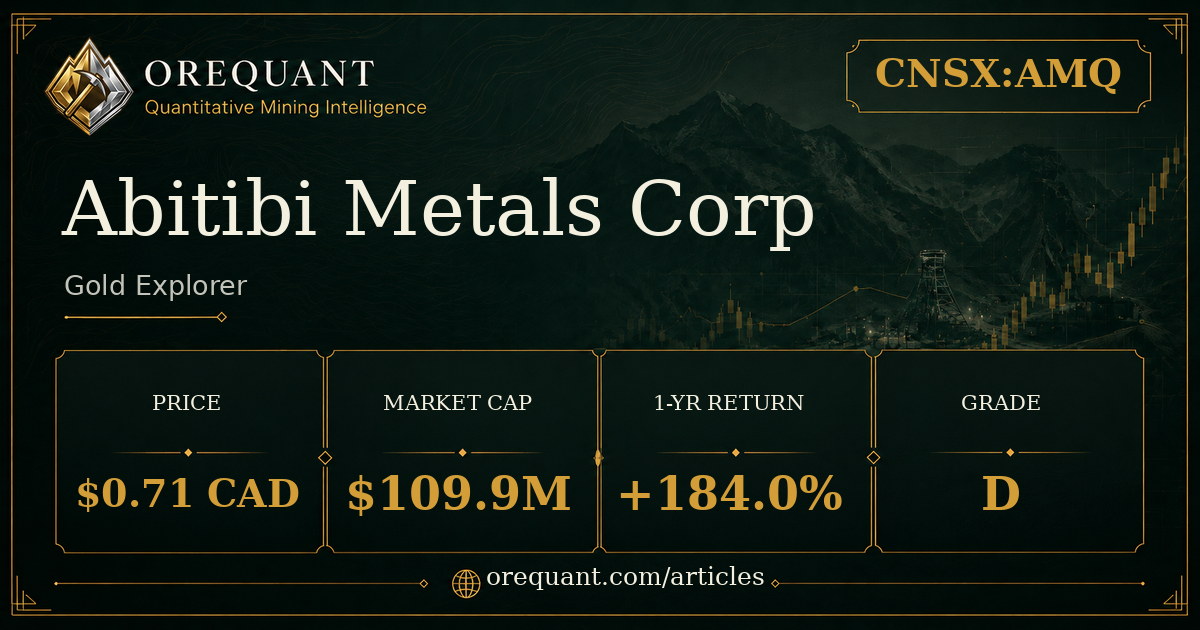
| Share price | $0.71 CAD |
|---|---|
| Market cap | $109.9M |
| 1-year return | +184.0% |
| 1-month return | -11.2% |
| OreQuant quality grade | D |
| Classification | explorer |
See the full signal depth behind this snapshot →
At a Glance
Abitibi Metals Corp (CNSX:AMQ) trades at C$0.71 per share with a market capitalization of approximately $109.9 million USD.
AMQ is classified as an explorer: a pre-production company focused on exploration and resource definition that may require external capital to advance its projects. That archetype designation frames every performance and financial figure that follows. The explorer classification is not a characterization of AMQ's ambitions or management intentions — it is a structural description of where the company sits in the mining development continuum.
Over the past month, AMQ is down 11.25%. Over the past year, the stock has returned 184% — a strong absolute figure that warrants careful context against the peer group and against the company's own fundamental development stage.
Among size-comparable peers, Big Ridge Gold Corp (CVE:BRAU) leads the cohort with a 257% one-year return. Xtra-Gold Resources Corp (TSE:XTG) posted 23%, Canagold Resources (TSE:CCM) returned 49%, Borealis Mining Company Ltd (CVE:BOGO) returned 46%, and Valiant Gold Ltd (ASX:VAL) was flat at 0%. AMQ's one-year gain ranks second in the peer set, despite carrying the same D-grade as Big Ridge Gold and Borealis Mining. The contrast with Xtra-Gold — the only A-grade name in the cohort, which posted a comparatively subdued return — illustrates that quality grade and near-term price momentum operate on different timescales in the junior gold sector.
AMQ records zero trailing twelve-month revenue. For an explorer at this stage of development, those figures reflect exploration spending and corporate overhead rather than operating performance in any conventional sense.
That structure is typical for the explorer archetype and means that share-price movements tend to be driven by exploration news flow, gold price direction, and broader junior-sector sentiment rather than earnings revisions.
Ground and Targets
Abitibi Metals Corp's operational focus is gold exploration in Québec, Canada. All five projects sit within a single province, concentrating both jurisdictional risk and jurisdictional opportunity in one geology-rich region.
The five named project positions are: the Beschefer Gold Project, Bonanza, B26, Beschefer, and the Horizon Property. Québec's Abitibi belt is among the most historically productive gold-bearing terranes in the Western Hemisphere, with established infrastructure, a well-developed mining regulatory framework, and proximity to processing facilities. The cluster of multiple named positions within a single belt is a common land-packaging strategy among junior explorers — it allows drill targeting across related geological structures while sharing logistical overhead.
Operating in a recognized gold belt does not guarantee exploration success, but it lowers some logistical and permitting barriers that explorers in more remote or frontier jurisdictions routinely face. The region benefits from an active community of major and mid-tier gold producers, supporting local technical talent, contractor availability, and established supply chains. Those practical advantages can translate into meaningful cost and timeline differences at the field-program level relative to greenfield or remote-access exploration programs.
AMQ carries no production estimate and no mine-life figure — standard attributes for an early-stage explorer that has not yet advanced any project to a feasibility or pre-feasibility stage. Any path to production for any of the Québec projects would require significant additional delineation drilling, resource definition work, permitting, environmental baseline studies, and capital allocation well beyond current operations.
OreQuant scores every company across 11 signal layers, updated daily. Start Your 7-Day Free Trial to see the full breakdown behind this snapshot.
Capital and Burn Rate
AMQ generated no revenue in the trailing twelve months — the expected condition for an exploration-stage company with no producing assets. The company depends entirely on external capital to fund drilling, field programs, and corporate overhead. This is an inherent feature of the explorer archetype, not a temporary anomaly, and it persists until a project reaches a revenue-generating milestone such as a royalty sale, streaming arrangement, or commercial production.
That figure represents ongoing outflows — primarily exploration expenditures and administrative costs — with no offsetting revenue stream. Every dollar spent advancing the Québec projects must be sourced from equity issuances, debt, or other external mechanisms.
Approximately 154.8 million shares are outstanding. For explorer-archetype companies, the share count is a structural variable to monitor over time: future capital raises typically involve new equity issuances, which dilute existing holders proportionately. The archetype definition is explicit — AMQ may require external capital to advance its projects — and the current financial profile confirms that dependency is active, not theoretical.
Why It Matters
The combination of a D-grade quality rating and an explorer archetype places AMQ in a segment of the junior gold market defined by high uncertainty and elevated capital dependency. It is a snapshot, and snapshots of early-stage explorers can shift meaningfully as exploration programs produce results and the information base expands.
AMQ's share price more than tripled over the past year while the company remains pre-revenue and pre-production. That disconnect between price performance and fundamental development progress is a characteristic feature of junior gold explorers during periods of elevated gold price sentiment and active junior-sector participation.
The peer comparison sharpens the picture considerably. Yet Big Ridge Gold also carries a D-grade — reinforcing that grade classifications among junior explorers at this market-cap level do not correlate neatly with short-term price performance. Grade and near-term price performance demonstrably do not move in lockstep in the junior explorer space, and treating them as correlated would misread both signals.
A portfolio of named positions in the Abitibi belt gives AMQ multiple potential drill targets, each capable of producing news flow independently. That optionality — spread across Beschefer Gold Project, Bonanza, B26, Beschefer, and Horizon Property — means the company is not dependent on a single hole or a single structure to sustain market engagement through an exploration cycle.
Québec's Abitibi belt provides a meaningful jurisdictional anchor — a proven gold address with infrastructure, technical labor, and regulatory clarity relative to frontier exploration environments. With all projects in early delineation, AMQ's development catalysts remain ahead of it. OreQuant's gold coverage tracks companies at this stage as those catalysts take shape, and the D-grade cohort across the junior gold space continues to be monitored for the transitions — upward or downward — that exploration results and capital events drive over time.
Sector peer comparison
| Company | Ticker | Market cap | 1-yr return | Grade |
|---|---|---|---|---|
| Big Ridge Gold Corp | BRAU | $110.1M | +257.0% | D |
| Xtra-Gold Resources Corp | XTG | $110.2M | +23.0% | A |
| Canagold Resources | CCM | $109.1M | +49.0% | C |
| Valiant Gold Ltd | VAL | $110.7M | — | C |
| Borealis Mining Company Ltd | BOGO | $110.8M | +46.0% | D |
Peers ranked by market-cap proximity within the same commodity and producer tier. Market data and quality grades are public; OreQuant's full signal-layer scores are subscriber-only.
Frequently Asked Questions
What projects does Abitibi Metals Corp hold in Québec?
AMQ holds five named project positions in Québec: the Beschefer Gold Project, Bonanza, B26, Beschefer, and the Horizon Property. All are at the exploration stage with no production timeline established.
How has AMQ's share price performed over the past year?
AMQ returned 184% over the trailing twelve months, ranking second among its five size-comparable peers. Over the most recent month, the stock declined 11.25%.
What does AMQ's D-grade quality rating mean?
The D-grade is a relative OreQuant rating band based on current public-data scoring. It does not independently establish management quality, financing capacity, operational maturity, or balance-sheet strength.
What is the significance of AMQ's Québec jurisdiction?
Québec's Abitibi belt is among the most historically productive gold-bearing terranes in the Western Hemisphere. Operating there provides access to established infrastructure, a developed regulatory framework, and proximity to processing facilities — logistical advantages relative to more remote exploration jurisdictions.
Risk & Disclosure
Gold mining equities carry substantial risk including commodity-price volatility, operational disruptions, jurisdictional changes, and capital allocation missteps. Senior producers mitigate some risks through diversification and scale, but remain sensitive to metal prices, cost inflation, and geopolitical developments. Junior and exploration-stage companies carry additional risk including total loss of capital. Past performance does not predict future results.
Investors should be prepared for double-digit intraday swings and should conduct independent due diligence, assess risk tolerance, and consult a licensed financial professional before initiating or modifying positions in mining equities.
OreQuant is not a registered investment advisor. This content is for informational and educational purposes only. It is not investment advice. Always conduct your own due diligence and consult a licensed financial professional before making investment decisions. Mining equities — especially juniors — carry substantial risk including total loss of capital.
Subscribers access the full signal depth behind this snapshot — individual scores, insider cluster details, Monte Carlo valuation, and position sizing updated daily. Start Your 7-Day Free Trial.