Caprice Resources Ltd (CRS) July 2026 Snapshot: D-Grade Gold Explorer
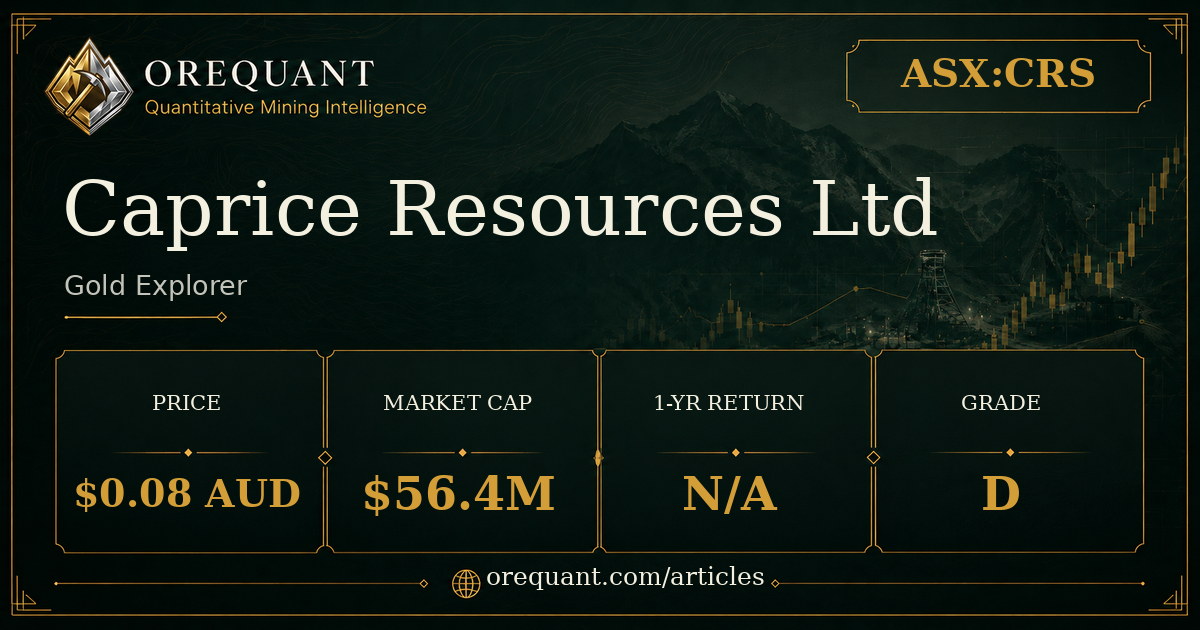
| Share price | $0.08 AUD |
|---|---|
| Market cap | $56.4M |
| OreQuant quality grade | D |
| Classification | explorer |
See the full signal depth behind this snapshot →
At a Glance
Caprice Resources Ltd (ASX:CRS) is a pre-production gold explorer operating exclusively in Australia, rated D under OreQuant's relative classification system. The market cap stands at approximately USD 56.4 million, with shares priced at USD 0.083 in Australian dollar terms.
CRS generated zero revenue over the trailing twelve months (FY2025) and posted a net loss over the same period. Both figures are consistent with a company at the exploration stage, where capital is deployed toward resource definition rather than production. No production schedule has been established, and the company's archetype — pre-production explorer — explicitly anticipates the potential need for external capital to advance projects.
That stasis is notable against a backdrop of active project-level activity, including the completed acquisition of the Viper Project and the divestment of the West Arunta asset. The concurrent reshaping of the portfolio signals a deliberate concentration toward gold-focused priorities. High-grade gold drill results at the Island Gold system and metallurgical testwork confirming strong gold recovery represent the most recent technical newsflow from the company, and both developments carry potential to influence the project's advancement trajectory.
Business Overview
Caprice Resources is a single-commodity, single-jurisdiction explorer with all operations confined to Australia. The pre-production explorer archetype means the company is engaged in exploration and resource definition, with no current mining revenue and no declared path to production. As the archetype definition notes, external capital may be required to advance projects — a structural condition that applies across all assets in the portfolio.
The project portfolio spans multiple named assets within Australia: the Mukinbudin Project, the Murchison Gold Projects, the Northampton Project, and the Wild Horse Hill project. A separate Murchison-jurisdiction asset rounds out the portfolio. These tenement packages reflect a geographically distributed exploration strategy within Western Australia, with different projects at varying stages of technical maturity.
Simultaneously, the West Arunta asset was divested — a rationalization that narrows focus toward higher-priority gold targets and reduces the portfolio's geographic and commodity spread. The net effect of these two concurrent transactions is a portfolio that is both larger by number of gold-oriented assets and more concentrated by commodity focus.
The Island Gold system has returned high-grade drill results and metallurgical testwork confirming high gold recovery rates, marking it as the most technically active front within the current project set. At the exploration stage, metallurgical confirmation of gold recovery is a foundational prerequisite before a project can advance toward resource estimation or any form of scoping study. The fact that testwork has been completed and results confirmed adds technical credibility to the Island Gold system's near-term development path.
OreQuant scores every company across 11 signal layers, updated daily. Start Your 7-Day Free Trial to see the full breakdown behind this snapshot.
Performance Context
CRS's price is flat over both the one-month and one-year periods — an unusual degree of stasis for a junior gold explorer when several peers at comparable market capitalizations posted material gains over the same horizon. The market cap places CRS within a tight peer cluster by size, but the quality grades and price trajectories of those peers diverge sharply, illustrating that similar market capitalizations can mask very different underlying profiles.
Inventus Mining Corp (CVE:IVS) at USD 55.3 million with a B grade gained 57%, and A2 Gold Corp (CVE:AUAU) at approximately USD 57.9 million with an A grade gained 78%.
Across all five peers, every name recorded positive price movement over twelve months. That divergence reinforces the point that a quality grade reflects current public-data signals and does not predict price direction independently.
With zero TTM revenue and a net loss, CRS's market cap reflects exploration optionality and project newsflow rather than earnings power. At this stage, market cap is more a function of perceived exploration upside, portfolio activity, and broader gold market sentiment than any earnings-based metric.
Catalysts and Risk
The Viper Project acquisition and the concurrent West Arunta divestment reshape the portfolio's composition in a single reporting period.
At the project level, the Island Gold system provides near-term newsflow potential. High-grade drill results have been reported, and metallurgical testwork has confirmed high gold recovery rates. For an explorer at this stage, metallurgical confirmation is a technically meaningful milestone — it removes one category of processing risk that can otherwise stall project advancement. Progressing these results toward a defined resource estimate would mark a substantive step for a company still at the explorer stage, and the signal methodology would reflect a materially different technical profile if that milestone is reached.
Zero revenue and a net annual loss mean the company consumes cash without operational income to offset it. Pre-production explorers of this type routinely face financing requirements as exploration programs intensify, particularly when the portfolio is being actively expanded through acquisitions. With 679,454,714 shares outstanding, any capital raise carries structural implications for existing shareholders that are worth tracking through OreQuant's gold explorer coverage.
Per the supplied definition, it does not independently establish management quality, financing capacity, or operational maturity. The grade should be read as one input alongside the project-level technical evidence, peer comparison, and the broader macro context for Australian gold explorers.
Signal Context
Per the supplied definition, it reflects the current public-data score and does not independently speak to management quality, financing capacity, or operational maturity.
The share price has not responded to project-level newsflow — the Viper acquisition, the West Arunta divestment, Island Gold drilling, and metallurgical confirmations have collectively not translated into price movement over the measured periods. For a junior explorer, the absence of price response to positive technical newsflow is worth monitoring, as it can reflect either broader market indifference to the name or an overhang from other structural factors. Neither interpretation can be confirmed from public data alone.
The most structurally meaningful development to track at CRS is the progression of the Island Gold high-grade system toward a formally defined resource. That milestone would represent a material shift in the company's technical profile — moving from drill-result-stage exploration toward resource-stage status, a transition that the peer-relative scoring framework would weight differently. Portfolio rationalization through the Viper acquisition and West Arunta divestment provides a cleaner strategic focus, but the Island Gold system's technical trajectory remains the central variable in how CRS's public-data profile evolves from this point.
Sector peer comparison
| Company | Ticker | Market cap | 1-yr return | Grade |
|---|---|---|---|---|
| Resolution Minerals Ltd | RML | $56.2M | — | A |
| Royal Road Minerals Ltd | RYR | $55.9M | +82.0% | A |
| EMC Gold Corporation | EM3 | $55.8M | +348.0% | D |
| Inventus Mining Corp | IVS | $55.2M | +57.0% | B |
| A2 Gold Corp | AUAU | $57.9M | +78.0% | A |
Peers ranked by market-cap proximity within the same commodity and producer tier. Market data and quality grades are public; OreQuant's full signal-layer scores are subscriber-only.
Frequently Asked Questions
What projects does Caprice Resources Ltd currently hold?
The portfolio includes the Mukinbudin Project, the Murchison Gold Projects, the Northampton Project, and the Wild Horse Hill project, all in Australia. The Viper Project was added in July 2026 following the completion of its acquisition, while the West Arunta asset was divested at the same time.
What is Caprice Resources Ltd's quality grade and what does it mean?
CRS carries a D quality grade under OreQuant's relative classification system. Per the supplied definition, this is a relative rating band based on the current public-data score. It does not independently establish management quality, financing capacity, operational maturity, or balance-sheet strength.
What is the significance of the Island Gold system for Caprice Resources?
The Island Gold system is the most technically active project in the CRS portfolio. High-grade gold drill results have been reported, and metallurgical testwork has confirmed high gold recovery rates. Advancing this system toward a formally defined resource estimate would represent a material step in the company's exploration program.
Does Caprice Resources Ltd generate revenue?
No. CRS reported zero revenue over the trailing twelve months (FY2025), consistent with its pre-production explorer status. The company posted a net loss over the same period and has no established production schedule.
Sources
Primary documents
- Caprice Resources Ltd M96: Completion of Acquisition of Viper Project3 pages969.3KB · ASX · July 3, 2026 · View document
- Caprice Resources Ltd West Arunta Divestment Completed3 pages241.7KB · ASX · July 3, 2026 · View document
- Caprice Resources Ltd Metallurgical Testwork Confirms High Gold Recovery22 pages1.0MB · ASX · June 16, 2026 · View document
Risk & Disclosure
Gold mining equities carry substantial risk including commodity-price volatility, operational disruptions, jurisdictional changes, and capital allocation missteps. Senior producers mitigate some risks through diversification and scale, but remain sensitive to metal prices, cost inflation, and geopolitical developments. Junior and exploration-stage companies carry additional risk including total loss of capital. Past performance does not predict future results.
Investors should be prepared for double-digit intraday swings and should conduct independent due diligence, assess risk tolerance, and consult a licensed financial professional before initiating or modifying positions in mining equities.
OreQuant is not a registered investment advisor. This content is for informational and educational purposes only. It is not investment advice. Always conduct your own due diligence and consult a licensed financial professional before making investment decisions. Mining equities — especially juniors — carry substantial risk including total loss of capital.
Subscribers access the full signal depth behind this snapshot — individual scores, insider cluster details, Monte Carlo valuation, and position sizing updated daily. Start Your 7-Day Free Trial.