Challenger Gold (CEL) July 2026 Snapshot: C-Grade Gold Explorer
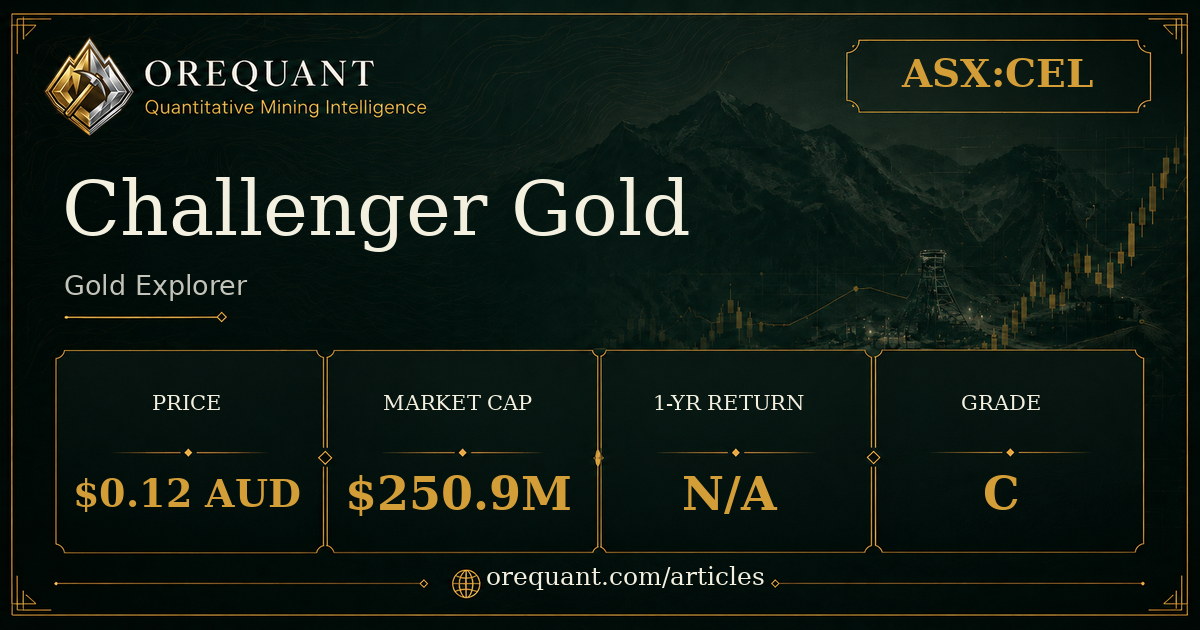
| Share price | $0.12 AUD |
|---|---|
| Market cap | $250.9M |
| 1-month return | +5.2% |
| OreQuant quality grade | C |
| Classification | explorer |
See the full signal depth behind this snapshot →
At a Glance
Challenger Gold (ASX:CEL) is a C-grade gold explorer with a market capitalization of approximately $250.9 million USD. Priced at A$0.125 per share with roughly 2.007 billion shares outstanding, the company sits in the pre-production segment of the gold equities universe.
The company's archetype classification is explorer — defined as a pre-production company focused on exploration and resource definition that may require external capital to advance its projects. The explorer classification is not a temporary label; it reflects the company's actual stage of development across all three of its projects.
Per the supplied definition, it does not independently establish management quality, financing capacity, operational maturity, or balance-sheet strength. Among the five peer comparables in the same market-cap cohort, CEL is one of two companies carrying a C grade — the other being Tudor Gold Corp on the TSX Venture Exchange.
CEL returned 5.2% over the past month and 0.0% over the trailing twelve months. The flat one-year return contrasts with peers in the same market-cap cohort, several of which posted substantial gains over the same period.
Revenue for the trailing twelve months ending December 31, 2025 stands at zero, consistent with the explorer archetype. The net income figure for the same period is positive — an atypical outcome for a pre-revenue explorer that is examined in the financial section below.
Ground and Targets
Challenger Gold operates three projects across South America, spanning two jurisdictions: Argentina and Ecuador. The portfolio includes the Hualilan Project in Argentina, plus the El Guayabo Project and the Colorado V project in Ecuador. A dual-country footprint introduces two distinct regulatory, permitting, and political environments for an ASX-listed entity to manage simultaneously — a complexity that single-jurisdiction peers do not face in the same form.
Ecuador hosts large-scale copper-gold systems in its southern Andean belt. The regulatory environment has seen renewed activity from international miners. The El Guayabo and Colorado V projects place CEL in a jurisdiction where land access and permitting timelines remain material variables for any exploration program. Operating two separate projects within Ecuador does provide some internal diversification of exploration targets, though both remain subject to the same national regulatory framework.
Argentina hosts long-established gold mining districts, and the Hualilan Project sits within that context. Junior explorers have historically found the jurisdiction accessible for early-stage work, though macroeconomic volatility has periodically complicated capital allocation decisions. The Hualilan Project represents CEL's single Argentine asset, concentrating the company's exposure to that jurisdiction's economic and regulatory conditions in one project.
Among the peer group — Vista Gold Corp , Tudor Gold Corp, Chesapeake Gold Corp, Solstice Minerals, and Dynacor Group — CEL is the only company with a dual South American country footprint. Most peers operate as single-jurisdiction or North American-based explorers.
All three of CEL's projects carry a consistent commodity focus: gold. There is no base-metal or diversified commodity exposure within the disclosed project portfolio, which means the company's exploration value is directly tied to gold price dynamics and gold-specific market sentiment. For a company operating at this stage, single-commodity concentration is a common structural feature of the explorer archetype.
OreQuant scores every company across 11 signal layers, updated daily. Start Your 7-Day Free Trial to see the full breakdown behind this snapshot.
Capital and Burn Rate
Challenger Gold recorded zero revenue for the trailing twelve months through December 31, 2025. This is the expected financial profile for a company classified as an explorer: no production means no operating revenue. The archetype definition is explicit — such companies may require external capital to advance their projects, making financing and potential dilution an ongoing structural consideration.
The net income figure for the same period is approximately $53.6 million USD — a positive number that is uncommon for a pre-revenue explorer. Net income at an exploration-stage company bearing zero revenue typically reflects non-cash items, asset revaluations, or one-time disposals rather than operational earnings. Readers should treat the headline positive net income alongside the zero-revenue base, not as evidence of operational profitability.
Peers in the same market-cap band — Tudor Gold (C-grade), Chesapeake Gold (B-grade), Vista Gold (A-grade), Solstice Minerals (A+-grade), and Dynacor Group (A+-grade) — span a wide quality range. Market-cap proximity does not imply equivalent financial resilience or project maturity. The spread from C-grade to A+-grade within a narrow market-cap band underscores that headline capitalization is a limited proxy for underlying company quality at this tier of the gold equities market.
For explorer-stage companies, the structural question is always capital runway. Among the peer group, higher-graded companies may carry different capital access profiles, but the public data does not supply individual cash-position figures for direct comparison.
Why It Matters
The C-grade rating and explorer archetype together define CEL's position: a pre-production gold company in an early-stage capital cycle, operating across two South American jurisdictions with no recorded revenue. Four of the five peer comparables carry higher quality grades. Three of those four — Dynacor Group, Vista Gold, and Chesapeake Gold — delivered positive one-year returns, while CEL returned a flat result over the same period.
Tudor Gold, the only peer sharing CEL's C grade, returned 67% over twelve months. Chesapeake Gold (B-grade) posted the strongest result in the cohort at 153%. CEL's flat one-year return places it at the bottom of a peer group that broadly participated in the gold equity rally. The recent one-month gain reflects some near-term momentum, but a single month of positive performance has not yet closed the trailing-year gap relative to peers at every quality grade above C.
Insider transaction data in the public record does not surface a recent cluster.
For a dual-jurisdiction South American gold explorer at the C-grade level, the key variables are exploration progress at Hualilan, El Guayabo, and Colorado V, alongside capital structure management. At this market-cap tier among ASX-listed gold explorers , project-level news flow carries disproportionate weight in driving any re-rating.
Sector peer comparison
| Company | Ticker | Market cap | 1-yr return | Grade |
|---|---|---|---|---|
| Vista Gold Corp | VGZ | $251.1M | +146.0% | A |
| Tudor Gold Corp | TUD | $250.0M | +67.0% | C |
| Chesapeake Gold Corp | CKG | $249.9M | +153.0% | B |
| Solstice Minerals Ltd | SLS | $249.3M | — | A+ |
| Dynacor Group | DNG | $255.0M | +48.0% | A+ |
Peers ranked by market-cap proximity within the same commodity and producer tier. Market data and quality grades are public; OreQuant's full signal-layer scores are subscriber-only.
Frequently Asked Questions
What is Challenger Gold's quality grade and what does it mean?
Challenger Gold carries a C grade under OreQuant's relative rating framework. Per the supplied definition, the grade is a relative rating band based on current public-data scoring. It does not independently establish management quality, financing capacity, operational maturity, or balance-sheet strength.
What projects does Challenger Gold operate?
Challenger Gold operates three projects: the Hualilan Project in Argentina, the El Guayabo Project in Ecuador, and the Colorado V project, also in Ecuador. All three are gold-focused and sit in South America.
How has CEL's share price performed relative to peers over the past year?
CEL returned 0.0% over the trailing twelve months. Among its five peer comparables, three delivered positive one-year returns — Dynacor Group at 48%, Vista Gold at 146%, and Chesapeake Gold at 153%. Tudor Gold returned 67%. Solstice Minerals also returned 0.0% over the same period.
Why does Challenger Gold report positive net income with zero revenue?
Net income of approximately $53.6 million USD alongside zero revenue is atypical for an exploration-stage company. Such outcomes typically arise from non-cash items, asset revaluations, or one-time disposals rather than operating earnings. The headline figure should be read alongside the zero-revenue base.
Risk & Disclosure
Gold mining equities carry substantial risk including commodity-price volatility, operational disruptions, jurisdictional changes, and capital allocation missteps. Senior producers mitigate some risks through diversification and scale, but remain sensitive to metal prices, cost inflation, and geopolitical developments. Junior and exploration-stage companies carry additional risk including total loss of capital. Past performance does not predict future results.
Investors should be prepared for double-digit intraday swings and should conduct independent due diligence, assess risk tolerance, and consult a licensed financial professional before initiating or modifying positions in mining equities.
OreQuant is not a registered investment advisor. This content is for informational and educational purposes only. It is not investment advice. Always conduct your own due diligence and consult a licensed financial professional before making investment decisions. Mining equities — especially juniors — carry substantial risk including total loss of capital.
Subscribers access the full signal depth behind this snapshot — individual scores, insider cluster details, Monte Carlo valuation, and position sizing updated daily. Start Your 7-Day Free Trial.