Barton Gold Ltd (BGD) July 2026 Snapshot: B-Grade Gold Developer
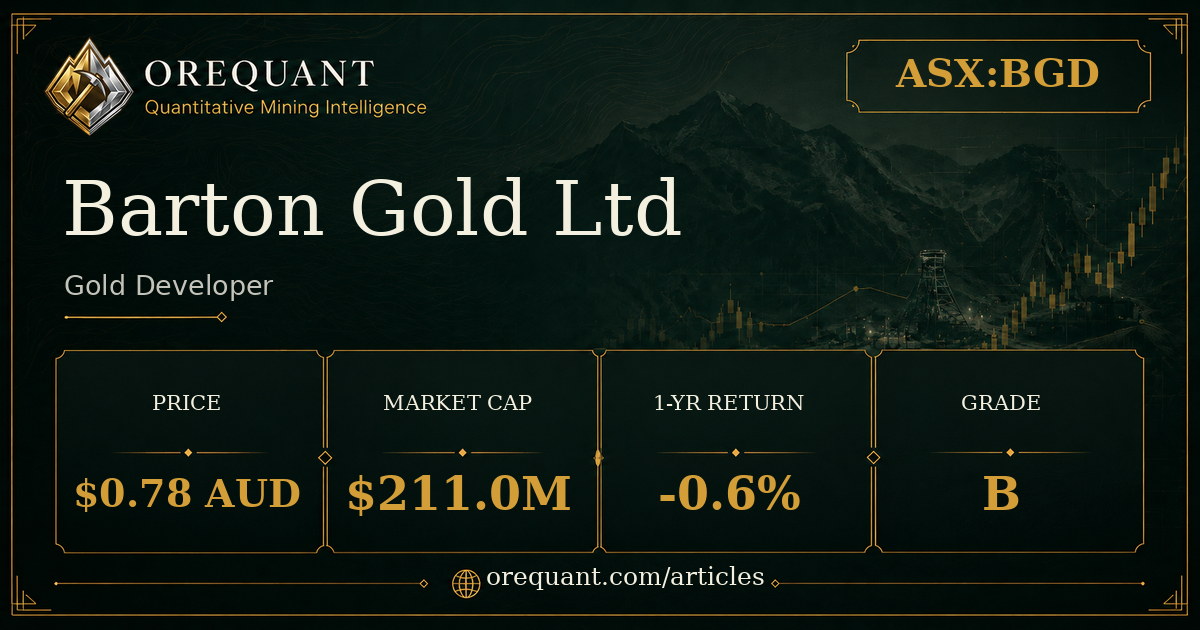
| Share price | $0.78 AUD |
|---|---|
| Market cap | $211.0M |
| 1-year return | -0.6% |
| 1-month return | -12.4% |
| OreQuant quality grade | B |
| Classification | developer |
See the full signal depth behind this snapshot →
At a Glance
Barton Gold Ltd (ASX:BGD) is a pre-production gold developer rated B-grade under OreQuant's grading framework. Its shares trade at A$0.78, implying a market capitalization of approximately US$211 million across roughly 270.5 million shares outstanding. The entire project portfolio sits within Australia, concentrated in South Australia.
The headline corporate event is a A$26 million institutional placement completed in June 2026. For a developer at Barton Gold's stage, a placement of that scale is a material capital infusion relative to overall market capitalization. Proceeds are directed toward advancing the South Australian project portfolio, most notably the Tunkillia Gold Project, through feasibility work and concurrent drilling programs.
Barton Gold's trailing financials reflect its pre-production status. That loss profile is structurally consistent with the developer archetype — operating expenditure on project advancement runs ahead of any production-derived revenue. The B-grade rating is a relative OreQuant rating band and does not independently establish management quality, operational maturity, or financing capacity.
Tunkillia remains the primary value driver.
Business Overview
Barton Gold is classified as a developer — a pre-production mining company advancing one or more projects toward construction or production. The company's corporate home is at bartongold.com.au.
All of Barton Gold's projects are located in South Australia. The portfolio includes the Tunkillia Gold Project, the Tarcoola Gold Project, the Challenger Gold Project, and the Wudinna Project. Operating exclusively within a single Australian state concentrates both the regulatory environment and sovereign risk profile. South Australia has an established framework for mining permitting, which limits some of the administrative unpredictability associated with multi-jurisdiction developers. That single-jurisdiction footprint also reduces the coordination overhead that often complicates development timelines for companies operating across multiple regulatory regimes.
Tunkillia is the flagship asset, with active infill drilling and a Pre-Feasibility Study now under way — a stage gate marking the transition from resource definition toward economic assessment. The PFS initiation is a meaningful milestone: developers that have completed PFS work carry a more concrete cost and production framework that supports capital market conversations around project financing and construction sequencing.
The Challenger and Tarcoola assets represent additional inventory within the same jurisdiction. The Wudinna Project further extends the South Australian footprint. Across this portfolio, Barton Gold reports no annual gold production, consistent with its developer classification.
A separate drilling program at the Tolmer silver discovery adds commodity optionality to the portfolio. Silver remains a secondary focus relative to the gold-dominant project pipeline, but completed drilling provides data that will inform how management allocates exploration capital across the asset base in subsequent periods.
OreQuant scores every company across 11 signal layers, updated daily. Start Your 7-Day Free Trial to see the full breakdown behind this snapshot.
Performance Context
BGD shares have declined approximately 12.44% over the past month and are essentially flat over the past year, down roughly 0.59%. For a developer without operating cash flow, near-term price performance is often more sensitive to gold macro conditions and capital-market sentiment than to company-specific operational news. The one-month pullback coincides with an active period of corporate activity — the institutional placement in June and the PFS commencement — suggesting the share price reaction reflects broader market dynamics rather than project-specific deterioration.
Goldmining Inc (TSE:GOLD, D-grade) and St. Augustine Gold & Copper (TSE:SAU, D-grade) returned approximately 38% and 36%, respectively. Theta Gold Mines (ASX:TGM, A+-grade) and Tolu Minerals (ASX:TOK, A-grade) were roughly flat.
Peers at similar or smaller market caps captured meaningful upside in the same twelve-month window. The divergence is notable: two D-grade peers — carrying the lowest relative quality ratings in the cohort — posted among the strongest returns, while the A+-grade Theta Gold Mines was flat on the year. That pattern is a reminder that near-term share price performance within the developer universe does not map cleanly onto fundamental quality rankings. Sentiment, narrative timing, and commodity-specific tailwinds can drive price action independently of where a company sits in OreQuant's grading framework.
BGD's B-grade places it above the D-grade peers and below the A+ and A names in the same capitalization band. The Tunkillia PFS initiation represents the clearest near-term development milestone distinguishing BGD within this cohort — a study completion that would deliver a public economic assessment against which the market can evaluate the current market capitalization more concretely.
Catalysts and Risk
Proceeds fund the Tunkillia Pre-Feasibility Study and ongoing drilling programs across the South Australian portfolio. Institutional participation in the placement is a data point on capital market access — completing a raise of that size reflects appetite from professional investors for developer-stage exposure in the current gold environment.
Active infill drilling at Tunkillia and the Phase 2 upgrade drilling program represent the primary near-term technical catalysts. High-grade assay results from infill drilling — as referenced in recent company announcements — feed the resource model underlying the PFS and influence the study's eventual economic conclusions. The PFS initiation itself marks a formal milestone in the development timeline: completion of the study would provide a publicly available cost, production rate, and capital expenditure framework against which market participants can benchmark the current valuation.
A secondary drilling program at the Tolmer silver discovery adds commodity optionality to the portfolio, though gold remains the primary focus across the Tunkillia, Tarcoola, Challenger, and Wudinna projects. The completion of drilling at Tolmer advances that asset toward assay results that may inform future resource work.
Structural risk for BGD is consistent with the developer archetype. The company carries a net loss with no producing assets to offset ongoing expenditure. Progression toward production depends on successful feasibility outcomes, permitting, and future capital raises, each of which introduces execution risk.
South Australia's established mining regulatory environment moderates some permitting uncertainty relative to less mature jurisdictions, but does not eliminate execution risk. Single-jurisdiction concentration means that any regulatory or political development affecting South Australian mining policy carries portfolio-wide implications rather than being isolated to one project.
Signal Context
OreQuant's signal framework flags Barton Gold for further review at this stage of its development cycle. The signal picture is best read against the Tunkillia development timeline — a developer entering a feasibility study sits at an inflection point where financing activity and drilling results converge simultaneously. That combination of concurrent data streams creates a more information-dense environment for systematic signal interpretation than quieter periods of single-thread project work.
Institutional participation at the developer stage reflects professional capital's willingness to fund pre-production advancement, and the completion of the raise — rather than a withdrawn or reduced placement — provides a market-structure data point.
The gold macro backdrop bears directly on a pre-production Australian developer. When gold macro conditions are constructive, developers with active drilling programs and near-term feasibility milestones tend to attract re-rating attention from capital allocating into the sector. When conditions are less supportive, the absence of operating cash flow makes those same developers more vulnerable to sentiment-driven selling — a dynamic that the one-month price performance may partly reflect.
Insider activity is a qualitative signal worth monitoring at the developer stage, particularly around capital raises and feasibility milestones. OreQuant tracks this signal layer across the coverage universe; any directional shifts around BGD's current development calendar would be assessed in the context of the broader signal picture rather than in isolation.
BGD's B-grade places it in the middle of the identified peer cohort: above the D-grade peers and below the A+ and A names.
Sector peer comparison
| Company | Ticker | Market cap | 1-yr return | Grade |
|---|---|---|---|---|
| Amarc Resources Ltd | AHR | $218.6M | +43.0% | B |
| St. Augustine Gold & Copper Ltd | SAU | $202.2M | +36.0% | D |
| Theta Gold Mines Ltd | TGM | $192.3M | — | A+ |
| Tolu Minerals Ltd | TOK | $241.8M | — | A |
| Goldmining Inc | GOLD | $267.5M | +38.0% | D |
Peers ranked by market-cap proximity within the same commodity and producer tier. Market data and quality grades are public; OreQuant's full signal-layer scores are subscriber-only.
Frequently Asked Questions
What is the Tunkillia Gold Project's current development stage?
Tunkillia is in the Pre-Feasibility Study phase, having moved from active resource-definition drilling into formal economic assessment. Active infill drilling and a Phase 2 upgrade drilling program are running concurrently with the PFS.
What did Barton Gold use the A$26 million institutional placement proceeds for?
The proceeds are directed toward funding the Tunkillia Pre-Feasibility Study and ongoing drilling programs across the South Australian project portfolio.
How does BGD's one-year share performance compare to its identified peers?
BGD's trailing twelve-month return of approximately -0.59% is the lowest among its identified peer group. Peers ranged from flat (Theta Gold Mines, Tolu Minerals) to gains of approximately 36%–43% (St. Augustine Gold & Copper, Goldmining Inc, Amarc Resources).
What is Barton Gold's current quality grade and what does it mean?
Barton Gold carries a B-grade under OreQuant's grading framework. This is a relative rating band based on the current public-data score. It does not establish management quality, financing capacity, operational maturity, or balance-sheet strength.
Sources
Primary documents
- Barton Gold Ltd $26 Million Institutional Placement Completed3 pages273.5KB · ASX · June 10, 2026 · View document
- Barton Gold Ltd Expansion of Tunkillia Phase 2 Upgrade Drilling3 pages317.0KB · ASX · June 16, 2026 · View document
- Barton Gold Ltd Tunkillia Pre-Feasibility Study Begins6 pages656.6KB · ASX · June 22, 2026 · View document
Risk & Disclosure
Gold mining equities carry substantial risk including commodity-price volatility, operational disruptions, jurisdictional changes, and capital allocation missteps. Senior producers mitigate some risks through diversification and scale, but remain sensitive to metal prices, cost inflation, and geopolitical developments. Junior and exploration-stage companies carry additional risk including total loss of capital. Past performance does not predict future results.
Investors should be prepared for double-digit intraday swings and should conduct independent due diligence, assess risk tolerance, and consult a licensed financial professional before initiating or modifying positions in mining equities.
OreQuant is not a registered investment advisor. This content is for informational and educational purposes only. It is not investment advice. Always conduct your own due diligence and consult a licensed financial professional before making investment decisions. Mining equities — especially juniors — carry substantial risk including total loss of capital.
Subscribers access the full signal depth behind this snapshot — individual scores, insider cluster details, Monte Carlo valuation, and position sizing updated daily. Start Your 7-Day Free Trial.