Asara Resources Ltd (AS1) July 2026 Snapshot: D-Grade Gold Explorer
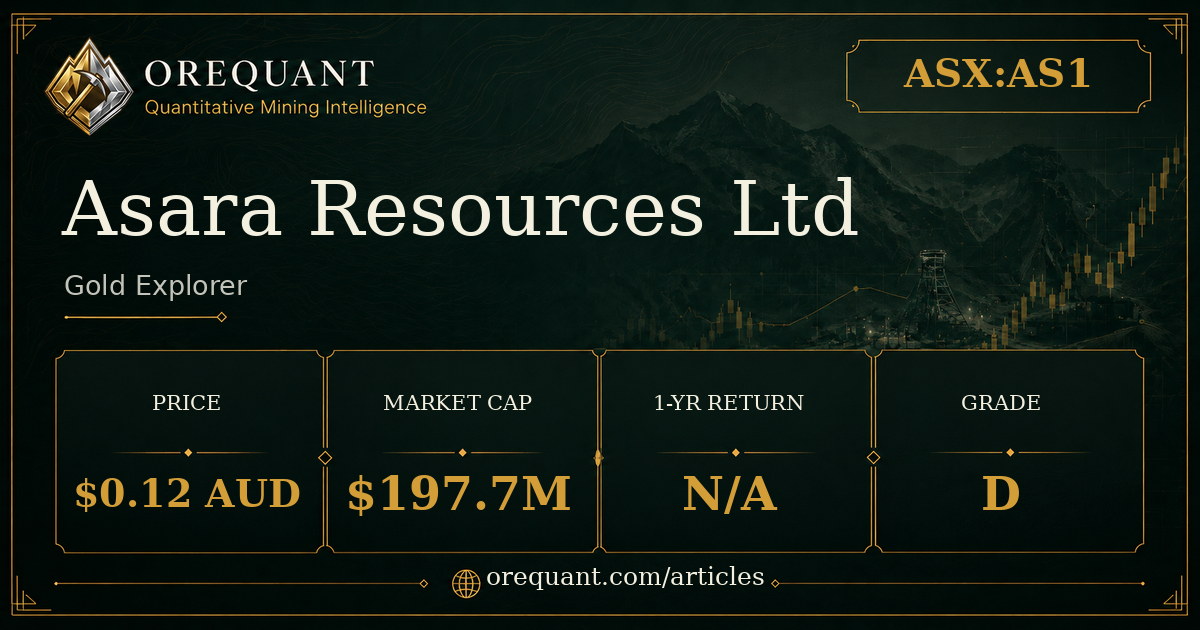
| Share price | $0.12 AUD |
|---|---|
| Market cap | $197.7M |
| OreQuant quality grade | D |
| Classification | explorer |
See the full signal depth behind this snapshot →
Headline Read
Asara Resources Ltd (ASX:AS1) is a pre-production gold explorer with zero reported revenue and no producing mines. At an approximate market capitalization of $198M USD, the company sits firmly in junior explorer territory.
As defined by its archetype, AS1 is a pre-production company focused on exploration and resource definition that may require external capital to advance its projects. With no production timeline recorded, the company's near-term value proposition rests entirely on exploration results rather than operational cash flow. That structural condition is common across the junior explorer cohort, but it makes the risk profile distinctly binary: outcomes are driven by what the drill bit returns rather than by any operating metric.
Ongoing drilling at the Massan deposit within the Kada project targets resource expansion in Guinea. Alongside that field activity, a placement and a proposed securities issuance are both on record — capital-raising activity consistent with a zero-revenue explorer sustaining concurrent field programs across multiple jurisdictions.
The share price is denominated in AUD, with approximately 1.65 billion shares outstanding — a share count that is material context when evaluating the market capitalization figure in absolute terms and in relation to any future capital raises.
Exploration Footprint
Asara Resources holds five named projects across Africa and South America, spanning three countries: Burkina Faso, Guinea, and Chile. The portfolio is weighted heavily toward West Africa by project count, with four of the five assets on that continent. Maintaining active programs across two continents simultaneously introduces a level of geographic dispersion that is atypical for a junior explorer at this market capitalization.
In Burkina Faso, the company holds the Kouri project. Guinea accounts for three assets: Sounkou, Sadan, and Damissa Koura. That concentration makes Guinea the dominant jurisdiction within the West African exploration footprint — by project count alone, Guinea represents the plurality of the portfolio.
Chile adds a base-metals dimension through the Loreto Copper project. While AS1's primary commodity classification is gold, Loreto Copper introduces exposure to a structurally distinct metal market with different demand drivers, different end-use industries, and different price dynamics than gold. This commodity and geographic spread is unusual at the junior explorer stage, where portfolios tend to be narrower in scope and capital is more concentrated around a single thesis.
Operating across multiple countries simultaneously introduces jurisdictional complexity — in permitting, community relations, and in-country logistics — that is relevant context when evaluating an explorer at this scale. Adding Chile as a third country and a second continent compounds that complexity further. Each jurisdiction carries its own regulatory framework and operating environment, and managing all three concurrently demands capital and management attention that a single-jurisdiction explorer does not face.
OreQuant scores every company across 11 signal layers, updated daily. Start Your 7-Day Free Trial to see the full breakdown behind this snapshot.
Balance Sheet Reality
Asara Resources reported zero revenue for FY2025, consistent with its pre-production status. The company recorded a positive net income figure for the period — a marginal result relative to the capital demands of running concurrent exploration programs across multiple countries and two continents. A positive net income at zero revenue typically reflects non-operating items rather than any form of operational self-sufficiency, and it does not alter the structural funding dependency that defines this archetype.
The financing backdrop has been active. A placement and a proposed securities issuance are both on record, consistent with a zero-revenue explorer sourcing external capital to sustain field operations. Each placement event also introduces the potential for dilution to existing shareholders, which is a structural feature of the pre-production explorer funding model rather than an anomaly specific to AS1.
Ongoing drilling at the Massan deposit requires sustained cash deployment with no operating inflows to offset it. Capital consumption without revenue support is the defining financial condition for pre-production explorers, and running that condition across five projects in three countries amplifies the cash demand relative to a single-project explorer.
The peer group provides useful scale context. The five comparable companies — Altair Minerals (ASX:ALR), Horizon Gold (ASX:HRN), Titan Minerals (ASX:TTM), 1911 Gold Corp (CVE:AUMB), and Revival Gold (CVE:RVG) — all trade within a narrow market capitalization band around AS1's figure, which limits the differentiation that market capitalization alone can provide in a peer comparison at this stage.
The Speculative Case
A multi-project, multi-continent portfolio distributes geological risk across jurisdictions. If one project fails to yield meaningful results, others remain active in the pipeline. However, spreading exploration activity across Burkina Faso, Guinea, and Chile also demands management bandwidth and capital allocation across distinct regulatory and operational environments simultaneously. That trade-off between diversification and execution complexity is a persistent feature of multi-jurisdiction junior explorer structures.
At the explorer stage, drill results carry outsized weight — positive intercepts can re-rate a junior quickly, while disappointments compress sentiment sharply. That concentration means drilling outcomes in Guinea will likely be the primary near-term catalyst for any valuation movement. No production timeline removes any near-term cash-flow support, making outcomes binary in character: resource expansion accelerates the path toward a development decision, while negative results return the project to a longer-dated exploration phase.
West African gold jurisdictions carry elevated sovereign and operational risk relative to OECD peers. Both Burkina Faso and Guinea have experienced political instability in recent years — a material consideration for companies whose primary assets are located there. These are not novel risks for investors in West African gold explorers, but they are persistent and non-trivial, particularly for a company without production cash flows to absorb disruption costs.
The D-grade quality rating places AS1 in a cohort that includes Altair Minerals (ASX:ALR), 1911 Gold Corp (CVE:AUMB), and Revival Gold (CVE:RVG). Notably, within that D-grade peer group, 1911 Gold Corp recorded a trailing one-year performance of approximately 238% and Revival Gold approximately 54%, demonstrating that D-grade classification does not preclude significant price movement — it reflects a risk profile, not a directional call. The Chile copper asset provides commodity differentiation, but it does not alter the fundamental risk profile of a pre-production explorer at this stage.
Signal Context
The peer group market caps form a tight cluster, as detailed in the Balance Sheet Reality section above. Within that cluster, the quality grade divergence is more informative: Horizon Gold (ASX:HRN) holds an A-grade and Titan Minerals (ASX:TTM) a B-grade at comparable market capitalizations, while AS1 and two of its peers sit at D-grade. That grade spread within a narrow market cap band reflects differentiated risk and quality assessments that the market capitalization figure alone does not capture.
The active financing backdrop — with a placement and proposed securities issuance on record — warrants qualitative attention for existing and prospective holders. Sequential capital raises in a short window can signal active project advancement, though they also introduce dilution dynamics that compound over time in a zero-revenue environment.
Most gold explorers in this rating band operate in a single commodity and a single region. Whether that distinction translates into exploration value depends on what the drill bit returns at Massan and the other Guinea assets, and ultimately on how the company allocates capital across its project pipeline from its available financing. Investors tracking AS1 can follow further gold explorer coverage for sector-level context.
Sector peer comparison
| Company | Ticker | Market cap | 1-yr return | Grade |
|---|---|---|---|---|
| Altair Minerals Ltd | ALR | $198.9M | — | D |
| Horizon Gold Ltd | HRN | $195.9M | — | A |
| Titan Minerals Ltd | TTM | $194.4M | — | B |
| 1911 Gold Corp | AUMB | $201.9M | +238.0% | D |
| Revival Gold Inc | RVG | $202.0M | +54.0% | D |
Peers ranked by market-cap proximity within the same commodity and producer tier. Market data and quality grades are public; OreQuant's full signal-layer scores are subscriber-only.
Frequently Asked Questions
What is Asara Resources' primary commodity focus?
AS1's primary commodity classification is gold. The company also holds the Loreto Copper project in Chile, which introduces base-metals exposure alongside the dominant gold exploration portfolio.
Where are Asara Resources' projects located?
AS1 holds five projects across three countries: Kouri in Burkina Faso; Sounkou, Sadan, and Damissa Koura in Guinea; and Loreto Copper in Chile. Four of the five assets are in West Africa.
Does Asara Resources generate revenue?
No. AS1 reported zero revenue for FY2025. The company is pre-production with no operating mines, and its financial position depends on external capital to fund exploration activity.
What quality grade does OreQuant assign to AS1?
OreQuant assigns AS1 a D-grade quality rating. This is a relative rating band based on the current public-data score and does not independently establish management quality, financing capacity, operational maturity, or balance-sheet strength.
Risk & Disclosure
Gold mining equities carry substantial risk including commodity-price volatility, operational disruptions, jurisdictional changes, and capital allocation missteps. Senior producers mitigate some risks through diversification and scale, but remain sensitive to metal prices, cost inflation, and geopolitical developments. Junior and exploration-stage companies carry additional risk including total loss of capital. Past performance does not predict future results.
Investors should be prepared for double-digit intraday swings and should conduct independent due diligence, assess risk tolerance, and consult a licensed financial professional before initiating or modifying positions in mining equities.
OreQuant is not a registered investment advisor. This content is for informational and educational purposes only. It is not investment advice. Always conduct your own due diligence and consult a licensed financial professional before making investment decisions. Mining equities — especially juniors — carry substantial risk including total loss of capital.
Subscribers access the full signal depth behind this snapshot — individual scores, insider cluster details, Monte Carlo valuation, and position sizing updated daily. Start Your 7-Day Free Trial.