Broken Hill Mines Ltd (BHM) July 2026 Snapshot: D-Grade Silver Producer
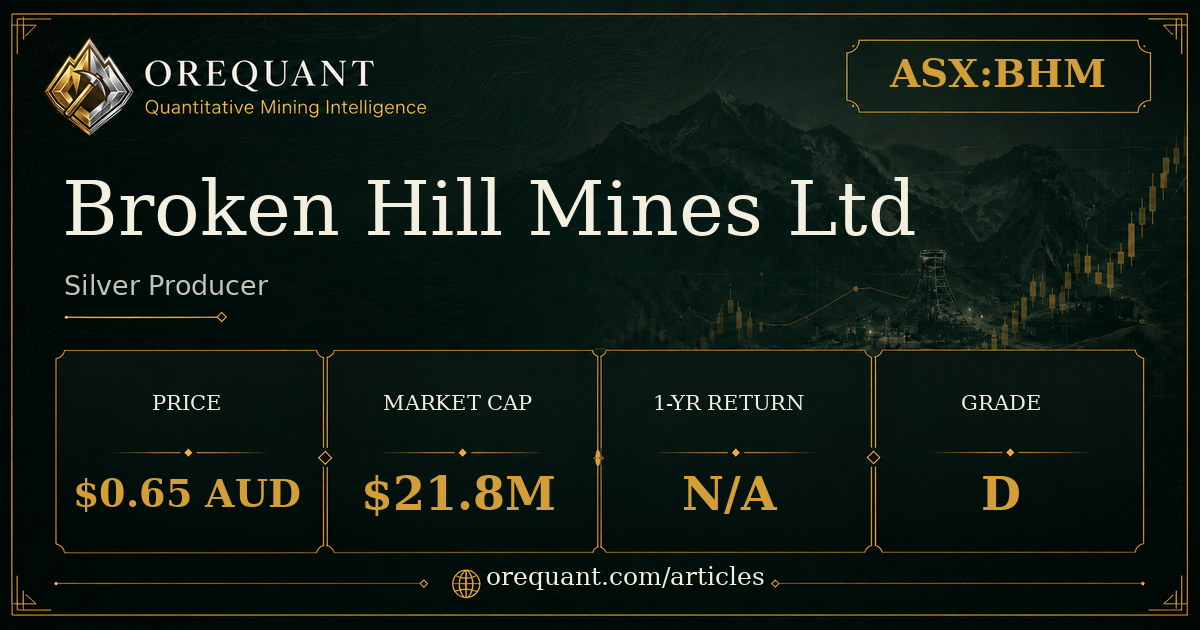
| Share price | $0.65 AUD |
|---|---|
| Market cap | $21.8M |
| OreQuant quality grade | D |
| Classification | producer |
See the full signal depth behind this snapshot →
Snapshot Summary
Broken Hill Mines Ltd (ASX:BHM) is a production-stage silver producer based in Australia, with active assets in New South Wales. OreQuant's grading framework assigns BHM a D-grade, a relative rating band in the current rated universe. Per the bounded definition, that rating does not independently establish management quality, financing capacity, or operational maturity.
BHM's share price stands at A$0.65, with a market capitalization of approximately $21.8 million USD. Named silver-sector peers all posted meaningful gains over the same one-year period — a visible divergence from BHM's flat trajectory. That gap in relative performance is notable given the broader tailwind that silver equities experienced across the peer set during the same window.
BHM's primary commodity is silver, with secondary exposure to lead and zinc through the Pinnacles Ag-Pb-Zn ore body and byproduct optionality in copper. That multi-metal profile distinguishes BHM from pure-play silver names and shapes its sensitivity to broader base-metal conditions. Investors treating BHM as a silver proxy should account for that polymetallic structure when evaluating how its share price behaves relative to silver spot.
By market capitalization, BHM sits well below its named silver peers: Pan American Silver Corp (~$18.4 billion USD), Hecla Mining Company (~$10.6 billion USD), and First Majestic Silver Corp (~$8.4 billion USD). BHM's position as a small-cap Australian producer operating in a single jurisdiction places it in a structurally different risk and liquidity category than those Americas-based silver majors.
Business Footprint
BHM operates entirely within a single jurisdiction — New South Wales, Australia. The company's asset base covers the Pinnacles Mine, the Rasp Mine, a processing plant, and the broader Pinnacles Ag-Pb-Zn project. This single-country concentration means the operating environment is shaped by Australian regulatory and permitting frameworks, rather than the Latin American or North American jurisdictions that dominate most named peers.
Silver is BHM's primary commodity, consistent with its article commodity designation. The Pinnacles Mine produces silver-lead-zinc ore, giving the company a polymetallic revenue stream. This ore mix is characteristic of the historic Broken Hill mineral field, where silver, lead, and zinc commonly occur together in the same deposit system. That geological context is relevant: it means BHM's realized revenue per tonne of ore processed reflects contributions from multiple metals, and shifts in lead or zinc prices carry weight alongside silver spot moves in determining the economics of each operating period.
Copper is classified as byproduct optionality for BHM, reflecting a moderate exposure score. The 120-day copper beta registers at approximately 0.74, indicating a meaningful — though not dominant — correlation between BHM's share price and copper price movements over that window. Specific copper production volumes, resource tonnage, and cost figures are not populated, consistent with copper's byproduct classification rather than a primary production focus.
BHM's archetype as an operating mining company with production-stage assets anchors the analytical frame. This is not an explorer or developer carrying purely optionality value; the company's financial results are directly linked to mine-level output and realized metal prices. The distinction matters when comparing BHM against early-stage names in the silver sector, where the absence of current revenue removes the earnings dimension from the analysis entirely.
The single-continent footprint — Oceania — also sets BHM apart from the multi-jurisdiction structures maintained by larger silver producers. While geographic concentration limits diversification across regulatory and fiscal regimes, it simplifies the operational structure and reduces currency-mismatch exposure relative to producers running assets across multiple continents simultaneously.
OreQuant scores every company across 11 signal layers, updated daily. Start Your 7-Day Free Trial to see the full breakdown behind this snapshot.
Financial Snapshot & Recent Catalysts
BHM reported trailing twelve-month revenue of approximately $32.2 million USD for FY2025. Operating costs and other charges materially exceeded realized revenue — a meaningful observation given that the net loss alone approached the company's total market capitalization.
BHM's entire market capitalization is smaller than its FY2025 revenue figure, yet the company operated at a substantial net loss. By contrast, Pan American Silver Corp, Hecla Mining, and First Majestic Silver — peers with market caps as noted above — each posted strong one-year price performance of 77%, 125%, and 174% respectively, while BHM's share price remained flat. That flat performance, measured across both the one-month and one-year horizons, suggests the market is discounting BHM's operational momentum against its cost structure rather than simply tracking silver spot.
Shares outstanding total approximately 33.5 million, a relatively tight share count for a small-cap producer. The price has not moved on either a one-month or one-year basis, an observable divergence from the broader silver equity trend visible across the peer set. A tight share count can amplify price moves in either direction when trading volumes shift, a structural characteristic worth noting for any analyst modeling liquidity under stress or opportunity scenarios.
The Pinnacles Mine has been the focus of recent operational activity, with the Rasp Mine and the broader New South Wales portfolio remaining part of the stated asset base. The Zinc and Processing Plant assets round out the production infrastructure, supporting the treatment of ore drawn from both underground operations. For a producer of BHM's scale, maintaining multiple active mine fronts alongside a processing facility represents a meaningful operational commitment relative to its market capitalization.
Signal Context — Why This Matters
BHM's D-grade rating, assessed through OreQuant's grading framework, places it in the lower tier of the rated silver producer universe. Across the dimensions the framework measures, BHM ranks toward the bottom of its peer group on a systematic, public-data basis. Among the named peers in the supplied data set, Pan American Silver Corp holds an A-grade, First Majestic Silver Corp and Hecla Mining Company each hold B-grades, and Hycroft Mining Holding Corp holds an F-grade — positioning BHM second from the bottom in grade terms within this specific peer comparison.
The copper beta of approximately 0.74 adds complexity to BHM's silver classification. Silver-focused investors holding BHM also carry meaningful exposure to copper price movements through the byproduct optionality embedded in the Pinnacles Ag-Pb-Zn system. In a macro environment where copper and silver diverge in direction or magnitude, BHM's share price may respond differently than a pure-play silver name — a structural characteristic worth incorporating into any position-sizing analysis. The copper exposure score of 55 out of 100 further quantifies this byproduct dimension, placing BHM at the midpoint of the copper-exposure range rather than at either extreme.
BHM's operational concentration in a single New South Wales district creates a different risk profile than diversified multi-country silver producers. Australia's regulatory environment is generally regarded as stable relative to Latin American peer jurisdictions, though that observation is descriptive rather than evaluative. For producers dependent on a single mine district, operational interruptions — whether technical, geological, or regulatory — carry outsized financial consequences relative to producers with multiple geographically dispersed assets absorbing the same disruption.
The aggregate picture for BHM is one of a small, flat-trading silver producer with a recently restarted flagship mine, a net loss that approached its entire market capitalization in the most recent fiscal year, and a copper beta that adds base-metal sensitivity to what is nominally a silver equity. Those characteristics collectively place BHM at the less liquid, higher-complexity end of the silver producer spectrum. The revenue-to-market-cap ratio and the magnitude of the net loss relative to equity value are the two financial data points that most sharply differentiate BHM from its rated silver peers, and both deserve explicit weighting in any comparative analysis that reaches beyond headline grade or commodity classification. Readers seeking the systematic signal layers underlying the D-grade can review the OreQuant methodology page for a full description of the public-data dimensions used in the scoring framework.
Sector peer comparison
| Company | Ticker | Market cap | 1-yr return | Grade |
|---|---|---|---|---|
| Hycroft Mining Holding Corp | HYMC | $2.0B | +801.0% | F |
| First Majestic Silver Corp | AG | $8.4B | +125.0% | B |
| Hecla Mining Company | HL | $10.6B | +174.0% | B |
| Pan American Silver Corp | PAAS | $18.4B | +77.0% | A |
Peers ranked by market-cap proximity within the same commodity and producer tier. Market data and quality grades are public; OreQuant's full signal-layer scores are subscriber-only.
Frequently Asked Questions
What commodities does Broken Hill Mines Ltd produce?
BHM's primary commodity is silver, with secondary exposure to lead and zinc through the Pinnacles Ag-Pb-Zn ore body. Copper is classified as byproduct optionality, reflecting a moderate exposure score rather than a primary production focus.
Where does BHM operate?
BHM operates exclusively in New South Wales, Australia. Its asset base includes the Pinnacles Mine, the Rasp Mine, a processing plant, and the Pinnacles Ag-Pb-Zn project — all within the same Australian jurisdiction.
How does BHM's market capitalization compare to its silver-sector peers?
BHM's market capitalization of approximately $21.8 million USD is substantially smaller than named peers: Pan American Silver Corp (~$18.4 billion USD), Hecla Mining Company (~$10.6 billion USD), and First Majestic Silver Corp (~$8.4 billion USD). The scale differential places BHM in a different liquidity category than those majors.
What does BHM's OreQuant quality grade reflect?
BHM carries a D-grade, which is a relative rating band based on public-data scoring within OreQuant's framework. Per the bounded definition, the grade does not independently establish management quality, financing capacity, operational maturity, or balance-sheet strength.
What does BHM's copper beta indicate?
BHM's 120-day copper beta of approximately 0.74 indicates a meaningful — though not dominant — correlation between its share price and copper price movements. Because copper is a byproduct component of the Pinnacles Ag-Pb-Zn system, BHM carries some base-metal sensitivity beyond its primary silver classification.
Risk & Disclosure
Silver mining equities carry substantial risk including commodity-price volatility, operational disruptions, jurisdictional changes, and capital allocation missteps. Senior producers mitigate some risks through diversification and scale, but remain sensitive to metal prices, cost inflation, and geopolitical developments. Junior and exploration-stage companies carry additional risk including total loss of capital. Past performance does not predict future results.
Investors should be prepared for double-digit intraday swings and should conduct independent due diligence, assess risk tolerance, and consult a licensed financial professional before initiating or modifying positions in mining equities.
OreQuant is not a registered investment advisor. This content is for informational and educational purposes only. It is not investment advice. Always conduct your own due diligence and consult a licensed financial professional before making investment decisions. Mining equities — especially juniors — carry substantial risk including total loss of capital.
Subscribers access the full signal depth behind this snapshot — individual scores, insider cluster details, Monte Carlo valuation, and position sizing updated daily. Start Your 7-Day Free Trial.