Brightstar Resources Ltd (BTR) July 2026 Snapshot: A-Grade Gold Developer
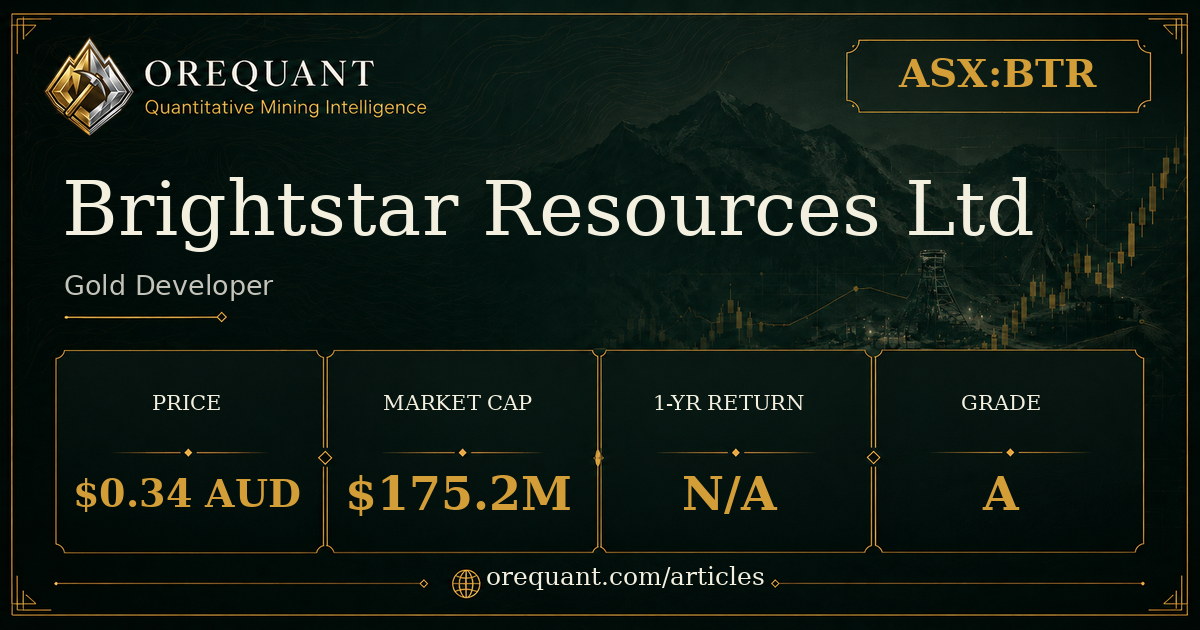
| Share price | $0.34 AUD |
|---|---|
| Market cap | $175.2M |
| OreQuant quality grade | A |
| Classification | developer |
See the full signal depth behind this snapshot →
At a Glance
Brightstar Resources Ltd (ASX:BTR) is an Australian gold developer advancing pre-production projects in Western Australia, carrying an A-grade quality rating under OreQuant's relative rating system and a production target of January 2027.
BTR's market capitalization sits at approximately $175.2 million USD, with a share price of $0.335 AUD and roughly 522.9 million shares outstanding. Those figures place the company firmly in junior developer territory — large enough to maintain liquidity on the ASX, yet still dependent on capital market access to fund the construction phase ahead.
The most recently reported period, FY2025, shows revenue of approximately $48.8 million USD alongside a net loss. That combination — meaningful revenue against a net loss — is characteristic of developers that have commenced some operational activity while still absorbing pre-production capital expenditure and exploration costs. The gap between top-line revenue and the bottom line reflects the structural economics of a company that has not yet reached the sustained cash generation phase that follows first commercial production.
It is not an investment recommendation and does not independently establish management quality, financing capacity, operational maturity, or balance-sheet strength. It situates BTR toward the stronger end of the peer cohort reviewed here. Among the five market-cap peers identified in public data, no comparable company carries an equivalent A-grade designation, making the relative positioning observable and distinct.
BTR registered flat movement over both the one-month and one-year periods reviewed. For a developer at this stage, flat year-on-year performance indicates no re-rating has occurred despite the project advancement timeline moving closer to the January 2027 production milestone.
The Asset
Brightstar's project portfolio is concentrated entirely in Western Australia, comprising five named assets: Second Fortune, Yunndaga, Selkirk, Fish, and Lord Byron. All five share a single jurisdiction, providing consistent regulatory exposure under a well-established mining framework. Each of these projects sits within a gold-producing state that has a multi-decade track record of hosting significant producing operations, lending BTR's portfolio a degree of geological and infrastructural context that greenfield jurisdictions typically cannot offer.
Western Australia operates under a legislative environment that global institutional investors generally regard as transparent and operationally predictable. Single-jurisdiction concentration brings both regulatory clarity and concentrated sovereign risk — two sides of the same structural position. For BTR specifically, operating exclusively within one state means that any jurisdiction-wide policy shift — such as changes to royalty rates or environmental permitting timelines — would affect the entire portfolio simultaneously rather than being offset by assets in other regions.
Gold is the sole commodity focus across the project portfolio, consistent with BTR's classification as a gold developer. No base-metal or secondary commodity exposure appears in public data for this company. This singular commodity focus means BTR's financial performance and investor positioning are directly correlated with the gold price cycle, without diversification into copper, silver, or other metals that some multi-commodity developers carry as partial hedges against gold-specific weakness.
The Goldfields and Sandstone project areas represent the two primary geographic clusters within the Western Australian portfolio. The Sandstone area, in particular, has been characterized in recent announcements as presenting a district-scale exploration opportunity, signaling that the portfolio's scope extends beyond near-term production assets into longer-dated resource definition work running in parallel.
OreQuant scores every company across 11 signal layers, updated daily. Start Your 7-Day Free Trial to see the full breakdown behind this snapshot.
Construction and Permitting Status
BTR's production target is set at January 2027, meaning the company has approximately six months to transition from developer to producer. That compressed timeline places immediate pressure on financing, permitting, and construction sequencing — all of which must converge within a narrow window. Developers at this stage of the archetype lifecycle are typically engaged in final feasibility confirmation, contractor procurement, and site preparation simultaneously, compressing what would ordinarily be sequential workstreams into a parallel execution challenge.
For a pre-production developer, this flag indicates that capital requirements associated with advancing projects toward first production require attention within that horizon. Pre-production developers routinely access equity markets, debt facilities, or offtake-linked financing structures to fund construction — the flag does not specify the mechanism, but it identifies the near-term capital event as a live variable.
The share count — as noted in the At a Glance section — already reflects a structure common among junior developers that have funded exploration through successive equity raises. The path to the January 2027 target involves navigating that capital market dynamic while maintaining project momentum across the five Western Australian assets.
Among the five peer companies shown at comparable market capitalization — Black Mammoth Metals (CVE:BMM), Generation Mining (TSE:GENM), Astral Resources (ASX:AAR), STLLR Gold (TSE:STLR), and Kenorland Minerals (CVE:KLD) — quality grades range from B to F. The contrast is sharpest against STLLR Gold, which carries an F grade despite a comparable market capitalization, and against Black Mammoth Metals and Generation Mining, both of which carry C grades. Astral Resources and Kenorland Minerals, both graded B, represent the closest qualitative comparators within the cohort, though neither closes the gap to BTR's A-level designation.
Signal Context
BTR's A grade sits against a backdrop of flat price performance over twelve months. This type of divergence — where fundamental grade positioning and market price action decouple — is a pattern that analysts monitoring junior developers typically flag as a point of ongoing attention, particularly when a production catalyst is within a calendar year's reach.
The gold commodity regime is the relevant macro backdrop for BTR. Australian-listed gold developers are exposed to both the USD gold price and the AUD/USD exchange rate. Domestic cost structures denominated in AUD can benefit when the local currency weakens relative to USD-priced gold revenue. This dual-currency exposure is a structural feature of Western Australian gold developers at this archetype, and it means BTR's realized economics at the point of first production will reflect not only the prevailing gold price but also the currency relationship at the time operational cash flows begin. The five projects concentrated in Western Australia share this same dual-currency dynamic, amplifying the relevance of gold-AUD pricing for the portfolio as a whole.
That partial revenue base provides a degree of operational context that pure-exploration developers at similar market capitalizations typically lack, though the net loss underscores that full production-phase economics have not yet been reached.
Relative to the five peers in the public dataset, BTR's A grade stands above Astral Resources and Kenorland Minerals (both B), Black Mammoth Metals and Generation Mining (both C), and STLLR Gold (F). Kenorland Minerals posted a one-year return of 27% and STLLR Gold posted 54%, while BTR's one-year performance remained flat — a divergence that illustrates how grade positioning and recent share price momentum can move independently within a comparable-cap peer cohort.
The combination of an A quality grade, a six-month production runway, and an active financing risk flag defines a near-term inflection point for BTR. How the company resolves its capital requirements over the coming months will be the primary observable that determines whether current grade positioning translates into project delivery across the five Western Australian assets.
Sector peer comparison
| Company | Ticker | Market cap | 1-yr return | Grade |
|---|---|---|---|---|
| Black Mammoth Metals | BMM | $174.6M | — | C |
| Generation Mining Ltd | GENM | $177.2M | — | C |
| Astral Resources NL | AAR | $171.7M | — | B |
| STLLR Gold | STLR | $168.3M | +54.0% | F |
| Kenorland Minerals Ltd | KLD | $183.2M | +27.0% | B |
Peers ranked by market-cap proximity within the same commodity and producer tier. Market data and quality grades are public; OreQuant's full signal-layer scores are subscriber-only.
Frequently Asked Questions
Where are Brightstar's projects located?
All five of BTR's projects — Second Fortune, Yunndaga, Selkirk, Fish, and Lord Byron — are located in Western Australia.
What does BTR's A quality grade mean?
The A grade is OreQuant's relative rating band based on the current public-data score. It is not an investment recommendation and does not independently establish management quality, financing capacity, operational maturity, or balance-sheet strength.
How does BTR's quality grade compare to its peers?
BTR's A grade stands above all five comparable-market-cap peers in the public dataset: Astral Resources and Kenorland Minerals (both B), Black Mammoth Metals and Generation Mining (both C), and STLLR Gold (F).
Risk & Disclosure
Gold mining equities carry substantial risk including commodity-price volatility, operational disruptions, jurisdictional changes, and capital allocation missteps. Senior producers mitigate some risks through diversification and scale, but remain sensitive to metal prices, cost inflation, and geopolitical developments. Junior and exploration-stage companies carry additional risk including total loss of capital. Past performance does not predict future results.
Investors should be prepared for double-digit intraday swings and should conduct independent due diligence, assess risk tolerance, and consult a licensed financial professional before initiating or modifying positions in mining equities.
OreQuant is not a registered investment advisor. This content is for informational and educational purposes only. It is not investment advice. Always conduct your own due diligence and consult a licensed financial professional before making investment decisions. Mining equities — especially juniors — carry substantial risk including total loss of capital.
Subscribers access the full signal depth behind this snapshot — individual scores, insider cluster details, Monte Carlo valuation, and position sizing updated daily. Start Your 7-Day Free Trial.