Arika Resources Ltd (ARI) July 2026 Snapshot: D-Grade Gold Explorer
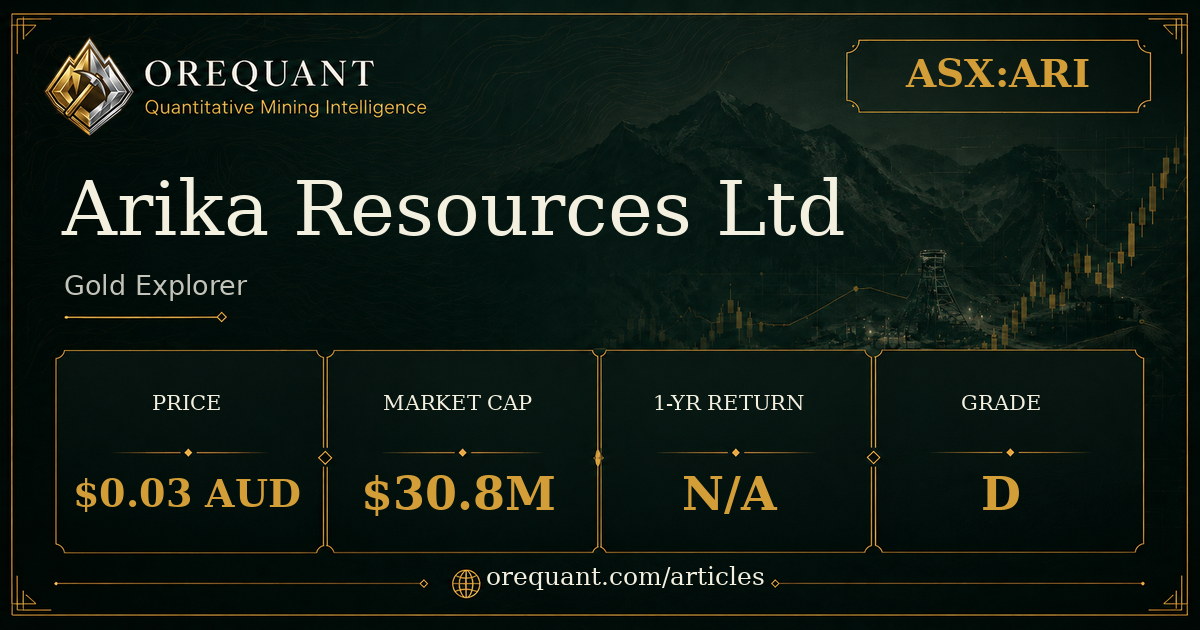
| Share price | $0.03 AUD |
|---|---|
| Market cap | $30.8M |
| OreQuant quality grade | D |
| Classification | explorer |
See the full signal depth behind this snapshot →
Quick Take
Arika Resources Ltd (ASX:ARI) is a pre-production gold explorer operating exclusively in Western Australia. It carries no revenue, is burning cash through active exploration, and is rated D-grade under OreQuant's relative quality framework — a relative rating band derived from public-data scoring that situates Arika within a population of comparable junior explorers on a quantitative basis.
The company is classified under the explorer archetype: a pre-production company focused on exploration and resource definition that may require external capital to advance its projects. All pre-resource explorers operate in a capital-consumption phase by definition, and Arika is no exception to that structural condition. The explorer archetype does not imply a specific financing timeline or capital structure outcome; it describes the stage of corporate development and the associated dependency on external funding sources.
Arika's market capitalization stands at approximately $30.8 million USD, with shares priced at AUD $0.025.
The Exploration Story
Arika's project portfolio is concentrated in Western Australia's Eastern Goldfields region, one of the world's most historically productive gold belts. The company holds the Yundamindra Gold Project and the Kookynie Gold Project, both acquired as part of a 100% interest purchase announced in mid-2026.
Western Australia offers a well-established regulatory environment, existing mining infrastructure, and a deep pool of geological expertise. For a small-cap explorer, operating within a single proven jurisdiction reduces sovereign risk and permitting complexity relative to peers active in multiple or frontier geographies. That concentration, however, cuts both ways: single-jurisdiction exposure also means the company's fortunes are tightly tied to WA's regulatory conditions, labor markets, and any regional permitting dynamics that affect the Eastern Goldfields specifically.
The Yundamindra and Kookynie tenements occupy ground within a belt that has hosted significant historical gold production across multiple mining cycles. For an explorer at the pre-resource stage, proximity to historical workings and known structural corridors can inform target generation and reduce early-stage exploration uncertainty — though historical production does not guarantee the presence of economically viable mineralization in any specific tenure package.
Among its closest market-cap peers — including Thunder Gold Corp (CVE:TGOL), Desert Gold Ventures (CVE:DAU), Kore Mining (CVE:KORE), Provenance Gold Corp (CNSX:PAU), and American Pacific Mining (CNSX:USGD) — Arika sits in a tightly clustered bracket ranging from approximately $30.4M to $31.8M USD. The spread across this five-company peer set is narrow enough that a single material announcement — positive or negative — can meaningfully shift relative positioning within the group. Desert Gold Ventures stands out within this peer group with a B-grade rating and 50% one-year price appreciation, illustrating the range of outcomes possible at similar market-cap scales when exploration momentum aligns with supportive market conditions.
OreQuant scores every company across 11 signal layers, updated daily. Start Your 7-Day Free Trial to see the full breakdown behind this snapshot.
Financing and Runway
The net loss reported for the trailing period represents the company's exploration burn rate over that window.
Burn rates for explorers are non-linear: a significant drilling program can compress a full year's runway into a matter of months if rig activity intensifies and assay backlogs require additional sampling.
The company's approximately 1.23 billion shares outstanding indicate a highly granular share structure typical of micro-cap ASX explorers that have historically raised capital through placements at low per-share prices. A share count at this scale reflects the cumulative history of equity issuance at fractions of a cent, and it sets the arithmetic for any future placement: even modest capital raises can introduce meaningful additional shares into an already large float, with corresponding implications for per-share economics.
A flat one-year return — while peer Desert Gold Ventures gained as noted in the previous section and American Pacific Mining fell sharply — suggests Arika has traded in a narrow band, neither attracting speculative momentum nor experiencing significant sell-side pressure over the measured period. That equilibrium is characteristically unstable in junior explorers: it tends to resolve decisively once drill results enter the market.
The central financing question for a pre-revenue explorer at this market-cap scale is whether the company can maintain drilling momentum without triggering dilutive capital raises at depressed prices. The relationship between project activity and cash draw will be the key variable to monitor as the current drilling campaign advances. Given the large existing share count, future placements structured at or near prevailing market prices would require careful management of placement size to avoid compressing the per-share price further.
Risk and Catalyst Path
Pre-resource gold explorers carry a binary risk profile by structural definition. A single drill campaign can rerate a junior explorer sharply in either direction, and Arika is positioned exactly at that inflection point with its active campaign now underway at both projects. The dual-project structure means the company has two distinct datasets generating in parallel — broadening the range of possible catalytic outcomes relative to a single-tenement explorer.
Western Australia is among the world's most miner-friendly jurisdictions. Established tenure systems, responsive regulatory agencies, and proximity to skilled labor and equipment reduce friction common in emerging-market geographies. WA is not immune to environmental permitting delays or labor cost pressures that affect all operators in the region, and the Eastern Goldfields specifically has seen periodic equipment availability constraints during periods of high regional drilling activity.
Drill results from the current campaign at Yundamindra and Kookynie represent the most immediate potential catalyst for ARI. Positive assay results capable of supporting a maiden resource estimate would constitute the most material near-term event, as the transition from explorer to resource-defined company typically opens access to a broader investor base and different analytical frameworks. The acquisition of both projects — referenced in the previous section — expands the exploration footprint and provides two distinct geological settings from which to generate targets, but structural tenement holdings do not substitute for in-ground results.
Conversely, American Pacific Mining, also in the same market-cap bracket and carrying a D-grade rating, declined substantially over the same period. The spread between those two outcomes, within the same peer cohort, illustrates the degree of outcome dispersion that characterizes the early-stage gold explorer universe.
Arika's D-grade rating, zero revenue, and flat price performance position it as a high-speculation, early-stage name. Within the peer bracket noted above, ARI's WA focus and active drilling program distinguish it operationally — but the fundamental risk remains entirely exploration-stage until drill results establish otherwise. Investors monitoring junior gold explorers in this market-cap range can contextualize ARI's signal profile relative to the broader cohort through OreQuant's quantitative framework, which layers structural, market, and activity signals across comparable names.
Sector peer comparison
| Company | Ticker | Market cap | 1-yr return | Grade |
|---|---|---|---|---|
| Thunder Gold Corp | TGOL | $30.9M | — | D |
| Desert Gold Ventures Inc | DAU | $31.1M | +50.0% | B |
| Kore Mining | KORE | $30.4M | +2.9% | D |
| Provenance Gold Corp | PAU | $31.7M | -21.7% | D |
| American Pacific Mining | USGD | $31.8M | -30.6% | D |
Peers ranked by market-cap proximity within the same commodity and producer tier. Market data and quality grades are public; OreQuant's full signal-layer scores are subscriber-only.
Frequently Asked Questions
What projects does Arika Resources Ltd hold?
Arika holds the Yundamindra Gold Project and the Kookynie Gold Project, both located in Western Australia's Eastern Goldfields region. The company acquired a 100% interest in both assets in mid-2026.
What is Arika's OreQuant quality grade and what does it mean?
Arika is rated D-grade under OreQuant's relative quality framework. This is a relative rating band based on public-data scoring. It does not independently establish management quality, financing capacity, operational maturity, or balance-sheet strength — it situates Arika within a population of comparable junior explorers on a quantitative basis.
How does Arika compare to its closest market-cap peers?
Arika's market-cap peers in the same bracket include Thunder Gold Corp, Desert Gold Ventures, Kore Mining, Provenance Gold Corp, and American Pacific Mining. Desert Gold Ventures holds a B-grade rating and posted 50% one-year price appreciation, while most peers in this bracket carry D-grade ratings. One-year returns across the group range from +50% to -30.61%.
What commodity does Arika Resources focus on?
Arika Resources focuses exclusively on gold, with both of its projects — Yundamindra and Kookynie — targeting gold mineralization in Western Australia.
Sources
Primary documents
- Arika Resources Ltd Securities to be Released from Voluntary Escrow1 page139.8KB · ASX · July 1, 2026 · View document
- Arika Resources Ltd Arika's Largest Ever Drilling Campaign to Commence9 pages1.8MB · ASX · July 8, 2026 · View document
- Arika Resources Ltd Acquisition of 100% of Yundamindra & Kookynie Projects7 pages1.4MB · ASX · June 5, 2026 · View document
- Arika Resources Ltd Notification of cessation of securities - ARI4 pages14.7KB · ASX · May 25, 2026 · View document
Risk & Disclosure
Gold mining equities carry substantial risk including commodity-price volatility, operational disruptions, jurisdictional changes, and capital allocation missteps. Senior producers mitigate some risks through diversification and scale, but remain sensitive to metal prices, cost inflation, and geopolitical developments. Junior and exploration-stage companies carry additional risk including total loss of capital. Past performance does not predict future results.
Investors should be prepared for double-digit intraday swings and should conduct independent due diligence, assess risk tolerance, and consult a licensed financial professional before initiating or modifying positions in mining equities.
OreQuant is not a registered investment advisor. This content is for informational and educational purposes only. It is not investment advice. Always conduct your own due diligence and consult a licensed financial professional before making investment decisions. Mining equities — especially juniors — carry substantial risk including total loss of capital.
Subscribers access the full signal depth behind this snapshot — individual scores, insider cluster details, Monte Carlo valuation, and position sizing updated daily. Start Your 7-Day Free Trial.